Quick Answer
Ashwagandha for stress and strength is genuinely one of the more well-researched Ayurvedic herbs available today, with a growing body of clinical studies exploring its role in supporting the body’s stress response and physical resilience. Research consistently shows Ashwagandha may help reduce cortisol, the body’s primary stress hormone, though its effect on how stressed people actually feel day-to-day has shown more mixed results across studies. Separately, some research has explored its potential role in supporting muscle strength and exercise recovery. Ashwagandha is best used as a supportive addition to a healthy lifestyle, not a standalone solution, and you should consult your doctor before starting it, especially if you’re on any existing medication.
Few Ayurvedic herbs have made the jump from traditional Indian households to global wellness shelves quite like Ashwagandha. But with so many products and claims out there, it’s worth understanding what this herb genuinely is, what research actually says, and what to know before you buy. In this article, we’ll explore Ashwagandha for stress and strength in detail, along with its Ayurvedic roots.
What Is Ashwagandha?
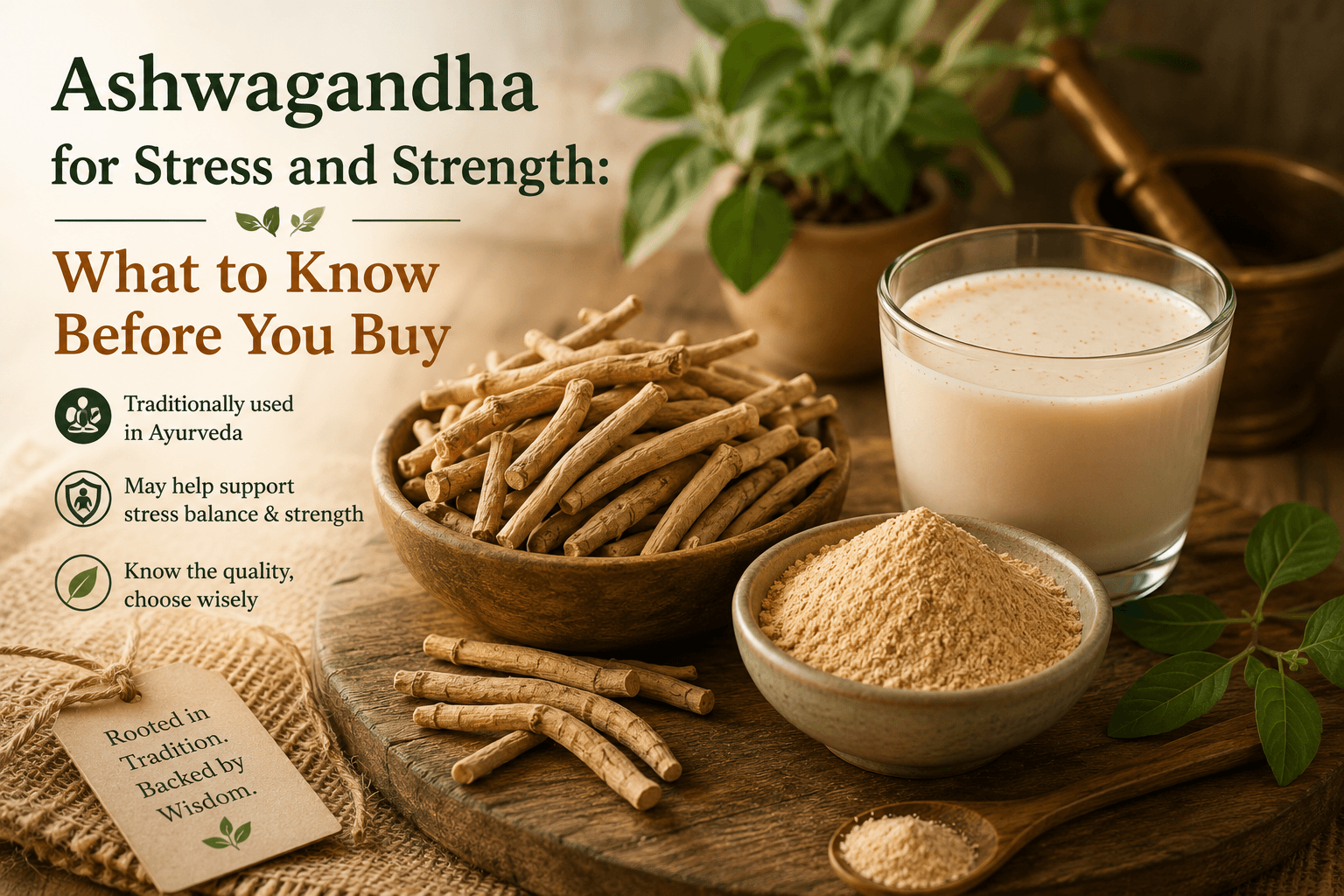
Ashwagandha, scientifically known as Withania somnifera, is a small shrub whose root has been used in Ayurvedic medicine for thousands of years. Classified as a “Rasayana,” or rejuvenating herb, and more specifically as an adaptogen, Ashwagandha has traditionally been valued for its believed ability to help the body adapt to physical and mental stress.
Understanding Ashwagandha for stress and strength starts with recognising that this herb bridges two distinct but related traditional uses — supporting the body’s response to stress, and supporting physical strength and vitality — both of which have increasingly drawn scientific attention in recent years.
Common Reasons People Explore Ashwagandha
People typically turn to Ashwagandha for stress and strength for a range of everyday concerns, including:
- Ongoing stress and its physical effects — One of the most researched and traditionally recognised uses of Ashwagandha.
- Difficulty winding down or sleeping well — Often linked to elevated stress levels.
- Reduced physical stamina or recovery — Some people explore Ashwagandha specifically for its potential role in supporting exercise performance and recovery.
- General fatigue and low resilience — In line with its traditional reputation as a broadly supportive Rasayana herb.
These reasons reflect the dual reputation Ashwagandha for stress and strength has built over time, both in traditional use and modern research circles.
Common Signs of Stress-Related Strain Worth Noticing
Before exploring supplements, it’s worth recognising the everyday signs that often prompt people to look into stress support:
- Persistent tension or difficulty relaxing
- Trouble falling or staying asleep
- Fatigue that doesn’t improve much with rest
- Irritability or feeling easily overwhelmed
- Reduced physical stamina or slower recovery after exertion
If these signs are significantly affecting your daily life, it’s worth speaking with a doctor, as ongoing stress and fatigue can sometimes be linked to underlying conditions that deserve proper evaluation rather than self-treatment alone.
What Does the Research Say About Ashwagandha for Stress and Strength?
Ashwagandha is genuinely one of the more extensively studied adaptogenic herbs, and it’s worth understanding the research honestly, including where findings are strong and where they’re more mixed.
Ashwagandha and Cortisol
Multiple randomized controlled trials and recent systematic reviews have consistently found that Ashwagandha supplementation significantly reduces cortisol levels, the body’s primary stress hormone, generally at doses ranging from 125 mg to 600 mg daily over periods of four to twelve weeks. This effect on cortisol is considered one of the more robust, well-replicated findings in Ashwagandha research.
Ashwagandha and Perceived Stress
Interestingly, while the cortisol-lowering effect is well established, research on how stressed people actually feel is more mixed. A comprehensive 2025 meta-analysis found that despite significant cortisol reduction, there was no statistically significant improvement in perceived stress scale scores. However, a separate 2024 meta-analysis using different study combinations did find meaningful improvements in both perceived stress and anxiety scores. This inconsistency suggests Ashwagandha’s biological effect on cortisol doesn’t always translate cleanly into how people subjectively feel, and that results may depend on the specific studies, populations, and durations involved.
Ashwagandha and Physical Strength
Separately, research has explored Ashwagandha’s role in physical performance. A study involving team sport athletes taking 600 mg daily during pre-season training found the herb helped stabilise physiological stress markers and supported measures of muscle strength and recovery perception during a demanding training period. Other studies have similarly explored Ashwagandha’s potential role in supporting muscle strength and exercise recovery, generally with encouraging, though still developing, results.
Taken together, this research paints an honest picture: Ashwagandha for stress and strength has genuinely solid evidence behind its effect on biological stress markers like cortisol, reasonably promising findings around physical performance and recovery, but more mixed evidence when it comes to how “stressed” people report feeling day-to-day. This kind of nuance is worth knowing before you buy, rather than relying on marketing claims alone.
What to Know Before You Buy Ashwagandha
If you’re considering Ashwagandha for stress and strength, here are practical things worth understanding:
- Check the standardization — Look for products that specify their withanolide content (Ashwagandha’s key active compounds), as this affects consistency and quality.
- Understand the dosage used in research — Most studies showing benefits use doses between 125 mg and 600 mg daily; check how your chosen product compares.
- Be patient — Most research shows benefits after several weeks of consistent use, not immediately.
- Choose reputable brands — Quality and purity can vary significantly between manufacturers.
- Understand it’s supportive, not a cure-all — Ashwagandha works best alongside other stress-management habits, not as a replacement for them.
Lifestyle Tips to Complement Ashwagandha
Ashwagandha for stress and strength works best when combined with supportive daily habits:
- Prioritise good sleep — Quality rest supports the body’s overall stress resilience.
- Stay physically active — Regular movement complements Ashwagandha’s potential role in supporting strength and recovery.
- Practice stress management techniques — Meditation, deep breathing, or yoga may work alongside Ashwagandha for more comprehensive support.
- Maintain a balanced diet — Overall nutrition supports the body’s resilience to stress.
- Be consistent — Regular, ongoing use tends to reflect the research more accurately than occasional use.
The Ayurvedic Perspective on Ashwagandha
In Ayurveda, Ashwagandha is traditionally believed to support “Ojas,” the subtle essence associated with vitality, strength, and resilience, while also helping balance Vata dosha, which governs the nervous system and is closely linked to stress and anxiety when imbalanced. Ashwagandha’s very name, derived from Sanskrit words meaning “smell of horse,” traditionally reflects its association with strength and vigour.
Ayurveda’s traditional approach to using Ashwagandha typically includes:
- Combined with warm milk — A traditional preparation, often taken at night, believed to support relaxation and restful sleep.
- As part of a broader Rasayana routine — Often combined with other traditional herbs and a supportive daily routine (Dinacharya) for comprehensive vitality support.
- Alongside mindful lifestyle practices — Ayurveda emphasises that herbs work best alongside supportive habits like proper rest, diet, and stress management, rather than as isolated remedies.
This traditional, holistic context adds useful perspective to modern research findings, reinforcing that Ashwagandha for stress and strength has always been understood as part of a broader approach to wellness, not a standalone fix.
Things to Keep in Mind Before Using Ashwagandha
While generally well-tolerated, a few points are worth considering:
- Ashwagandha may interact with medications for thyroid conditions, diabetes, blood pressure, and sedatives, so it’s important to consult your doctor if you’re on such treatment.
- Pregnant or breastfeeding women should avoid Ashwagandha unless specifically advised by a doctor.
- People with autoimmune conditions should consult a doctor before use, as Ashwagandha’s immune-modulating properties may not be suitable for everyone.
- Choose standardized, good-quality products from reputable brands for consistent dosing.
Frequently Asked Questions
1. Does Ashwagandha really help reduce stress?
Research consistently shows Ashwagandha significantly reduces cortisol, the body’s stress hormone, though its effect on how stressed people subjectively feel has shown more mixed results across different studies. It’s best viewed as one supportive tool among several for managing stress.
2. Can Ashwagandha help with muscle strength and exercise recovery?
Some research suggests Ashwagandha may help support physical performance markers and recovery, particularly during periods of intense training, though more research is needed to fully confirm these findings across broader populations.
3. How long does it take for Ashwagandha to work?
Most clinical studies showing benefits involve consistent use over four to twelve weeks, suggesting Ashwagandha works best as a gradual, ongoing addition to your routine rather than an immediate fix.
A Gentle Note Before You Go
Ashwagandha for stress and strength genuinely reflects a meaningful overlap between traditional Ayurvedic wisdom and modern research, though it’s worth approaching with realistic, well-informed expectations rather than hype. If you’re looking for gentle, everyday support alongside a balanced lifestyle, Healthywe’s range of strength and vitality herbal supplements is made using 100% natural, vegetarian ingredients rooted in traditional Ayurvedic wisdom.
As always, herbal supplements are meant to support your overall wellness, not replace medical care. Please consult your doctor or an Ayurvedic practitioner for proper diagnosis, and before making any changes to a prescribed treatment.
Explore our natural wellness range at www.healthywewellness.com/shop.