Quick Answer
Emotional eating means eating in response to feelings, such as stress, boredom, loneliness, sadness, or even celebration, rather than to physical hunger. It is extremely common and is not a character flaw. Researchers describe stress or emotional eating as part of a broader group of “disinhibited” eating behaviours, in which eating continues without physical hunger or beyond fullness, and it tends to be reinforced because food often brings a brief lift in mood. The first step is simply recognising your patterns: what you were feeling, what was happening around you, and what the urge felt like. From there, regular meals, getting enough sleep, building other ways to cope, mindful eating, and kindness towards yourself can all help. Strict dieting and “forbidden food” rules often make things harder, not easier. Emotional eating is different from binge eating disorder, a recognised condition involving repeated episodes of eating a large amount with a feeling of loss of control and significant distress, and that needs professional support. If you feel out of control around food, hide your eating, or feel very distressed, please speak to a doctor or mental health professional. This is general wellness information, not medical advice.
Most of us have reached for a biscuit after a bad day, ordered extra snacks during a stressful work week, or found that a plate of mithai disappears quickly during a family argument. Eating for comfort is a deeply human, and very Indian, thing: food is how we celebrate, console, welcome, and show love. The difficulty begins when food becomes the main or only way to manage difficult feelings, and you are left feeling uncomfortable, guilty, or stuck in a cycle. In this article we will explain what emotional eating is, how it differs from physical hunger, the common patterns, why it happens, how it differs from binge eating disorder, what practical strategies help, how it plays out in Indian homes and festivals, and what Ayurveda has taught about eating with awareness. Throughout, the tone is one of understanding, not blame.
What Is Emotional Eating?
Emotional eating is eating driven by emotions instead of hunger. The feeling might be unpleasant, such as stress, anxiety, sadness, anger, loneliness, or boredom. It can also be positive, such as celebrating, rewarding yourself, or enjoying a social occasion. Food in these moments serves a purpose: to soothe, distract, reward, or fill a gap.
Researchers place stress eating and emotional eating within a wider family of behaviours sometimes called disinhibited eating, which also includes binge eating and grazing or snacking without hunger. What they have in common is eating that is not guided by physical hunger and fullness signals, often involving tasty, energy-dense foods. Emotional eating is not rare, and it is not a sign of weakness. It is a learned way of coping, and like other habits, it can be understood and gently changed.
Physical Hunger vs Emotional Hunger
One of the most useful skills is learning to tell the two apart. They often feel different, though in the moment they can be hard to separate.
- Speed. Physical hunger usually builds gradually. Emotional hunger tends to come on suddenly and feel urgent.
- Type of food. Physical hunger is generally open to many foods. Emotional hunger often calls for a specific comfort food, such as something sweet, salty, crunchy, or fried.
- Where you feel it. Physical hunger tends to show up in the body, as an empty or rumbling stomach, low energy, or a headache. Emotional hunger can feel like it is in the mind, as a craving or a thought about food.
- Fullness. With physical hunger, you usually notice when you are satisfied and can stop. With emotional eating, you may keep eating past fullness, or not feel satisfied even when you are full.
- Timing. Physical hunger returns a few hours after eating. Emotional hunger can strike right after a meal, when you are not at all hungry.
- Afterwards. Physical hunger leaves you comfortable once you eat. Emotional eating may be followed by guilt, shame, or regret.
Keep in mind that this is a guide, not a rule. Real life is often a mix, and many people feel hungry and stressed at the same time. The aim is curiosity, not perfect classification.
Common Emotional Eating Patterns
Recognising your own pattern is half the work. See which of these sound familiar. They are everyday patterns, not diagnoses.
Stress Eating
Reaching for food when under pressure, such as before a deadline, during exams, or after a difficult conversation. Often it is crunchy, salty, or sweet food, and it can happen mindlessly while working or studying.
Boredom Eating
Eating because there is nothing to do, or to fill time, such as snacking while scrolling, watching a series, or working from home near the kitchen.
Reward Eating
Treating food as a prize for getting through a hard day or finishing a task: “I deserve this.” Rewarding yourself is fine occasionally, but when food becomes the only reward, it can become a pattern.
Comfort Eating When Low or Lonely
Turning to familiar, soothing foods when sad, lonely, or homesick, such as warm, sweet, or childhood foods.
Eating to Procrastinate or Avoid
Heading to the fridge when facing something uncomfortable, such as a difficult task or a decision you do not want to make.
Social and Habitual Eating
Eating because others are eating, because food is offered, or because of routines such as tea with biscuits at 5 pm, or snacks whenever guests arrive.
Late-Night Eating
Snacking at night when tired, wired, or alone, often when willpower is low and the day’s feelings catch up with you.
Celebration Eating
Overeating at festivals, weddings, and parties. This is usually normal and social, but it can fit into an emotional pattern if the feeling attached to the event, such as anxiety about family, is driving it.
The Restrict-and-Rebound Cycle
Strictly cutting back on food, skipping meals, or banning certain foods, and then eating a lot once willpower runs out. Many people experience this as a guilt-driven cycle. Strict food rules can make food feel more powerful, and extreme restriction may increase the chances of overeating later. Steady, regular eating is generally kinder to your appetite signals.
Why Does Emotional Eating Happen?
There is no single reason, and it would be wrong for anyone to tell you the cause of your own eating without knowing you. But research points to several common ingredients.
Food Can Bring Short-Term Relief
Researchers note that stress-related disinhibited eating is reinforced because eating tasty food can ease a negative mood in the moment. That brief relief teaches the brain that food works, so the urge returns next time. This does not mean you lack willpower. It is how habits form.
Stress Biology
Stress triggers hormones, including cortisol, and studies in both animals and people have linked stress to a stronger motivation for highly palatable food. The picture is complicated, though. Some research suggests that people who are prone to emotional eating may have a different cortisol response to stress than others, and that factors such as noticing and naming your body’s signals can play a role. This is an active area of research, and there is no simple hormone explanation that applies to everyone.
Difficulty Noticing and Naming Feelings
Research on emotional eating discusses things such as poor awareness of internal body signals and difficulty identifying emotions as possible contributors. If a rising tension in the body feels like “I need to eat,” food becomes the default answer to many different feelings. Learning to pause and name what you feel can be a useful skill.
Habits and Cues
Many patterns are tied to cues: a time of day, a place, a screen, a certain person, or a feeling. Over time, the cue triggers the urge almost automatically.
Sleep, Meals, and Physical State
Being tired, skipping meals, or being under-fuelled makes urges stronger and decisions harder. Often what looks like an emotional problem has a physical component, such as a long gap since the last meal.
Food Culture and Environment
In Indian families, food is love. Refusing a second helping may feel rude, mothers and relatives urge us to eat, sweets mark every occasion, and stressful times such as exams often come with extra snacks. Easy access to delivery apps and snack drawers adds to this. Understanding these influences helps you see that your behaviour is shaped by your surroundings, not simply your character.
Emotional Eating vs Binge Eating Disorder
It is important to understand where everyday emotional eating ends and where a clinical condition may begin. They are related, but they are not the same.
Binge eating disorder (BED) is a recognised eating disorder. According to the diagnostic manual used by clinicians, the central features are recurrent episodes of eating an unusually large amount of food in a short time, together with a feeling of loss of control during the episode, and significant distress about it. Episodes often involve eating very quickly, eating until uncomfortably full, eating a lot when not hungry, eating alone out of embarrassment, and feeling disgusted, depressed, or guilty afterwards. Unlike some other eating disorders, binge eating disorder does not involve regular compensatory behaviours such as purging. Doctors look at how often the episodes occur and for how long, and only a qualified clinician can make a diagnosis.
A rough way to think about it is that emotional eating is a pattern many people have to some degree, while binge eating disorder involves repeated episodes of loss of control and distress that interfere with life. Research suggests that emotional distress, such as stress, anxiety, and low mood, is closely linked with binge eating, and that anyone with high levels of compulsive or binge-type eating may benefit from professional support.
Signs It Is Time to Talk to a Professional
- Regularly eating large amounts of food in a short time with a feeling that you cannot stop
- Eating in secret, hiding food, or feeling ashamed about your eating
- Feeling very distressed, guilty, or disgusted with yourself after eating
- Using vomiting, laxatives, fasting, or excessive exercise to make up for eating
- Extreme dieting, strong fear of weight gain, or constant preoccupation with food, weight, or body shape
- Eating patterns that affect your health, relationships, work, or mood
- Feeling low, anxious, hopeless, or having thoughts of harming yourself
You deserve support, and there is no need to wait until things feel “bad enough.” A doctor, psychiatrist, clinical psychologist, or a dietitian who works with disordered eating can help. If you are in immediate danger, call the emergency number 112. For free, confidential mental health support in India, Tele-MANAS is available around the clock on 14416 or 1-800-891-4416, in many languages. For eating disorder-specific information outside India, the National Alliance for Eating Disorders is one organisation that offers a helpline.
Practical Ways to Work With Emotional Eating
These strategies are meant to be gentle, not strict. Pick one or two to start with, rather than trying everything at once.
1. Notice Before You Change
For a week or two, simply observe. When you eat or feel the urge to eat, jot down a few words: the time, what you were doing, what you were feeling, how hungry you were, and what you ate. The aim is not to judge yourself, but to learn your patterns. Many people find that a clear trigger, like a certain time of day or a specific type of stress, emerges quickly.
2. Eat Regularly
Skipping meals and long gaps make urges stronger. Try to eat at fairly regular times, include protein and fibre at meals, such as dal, curd, paneer, sprouts, vegetables, and whole grains, and avoid letting yourself get ravenous. For many people, this alone reduces the intensity of cravings.
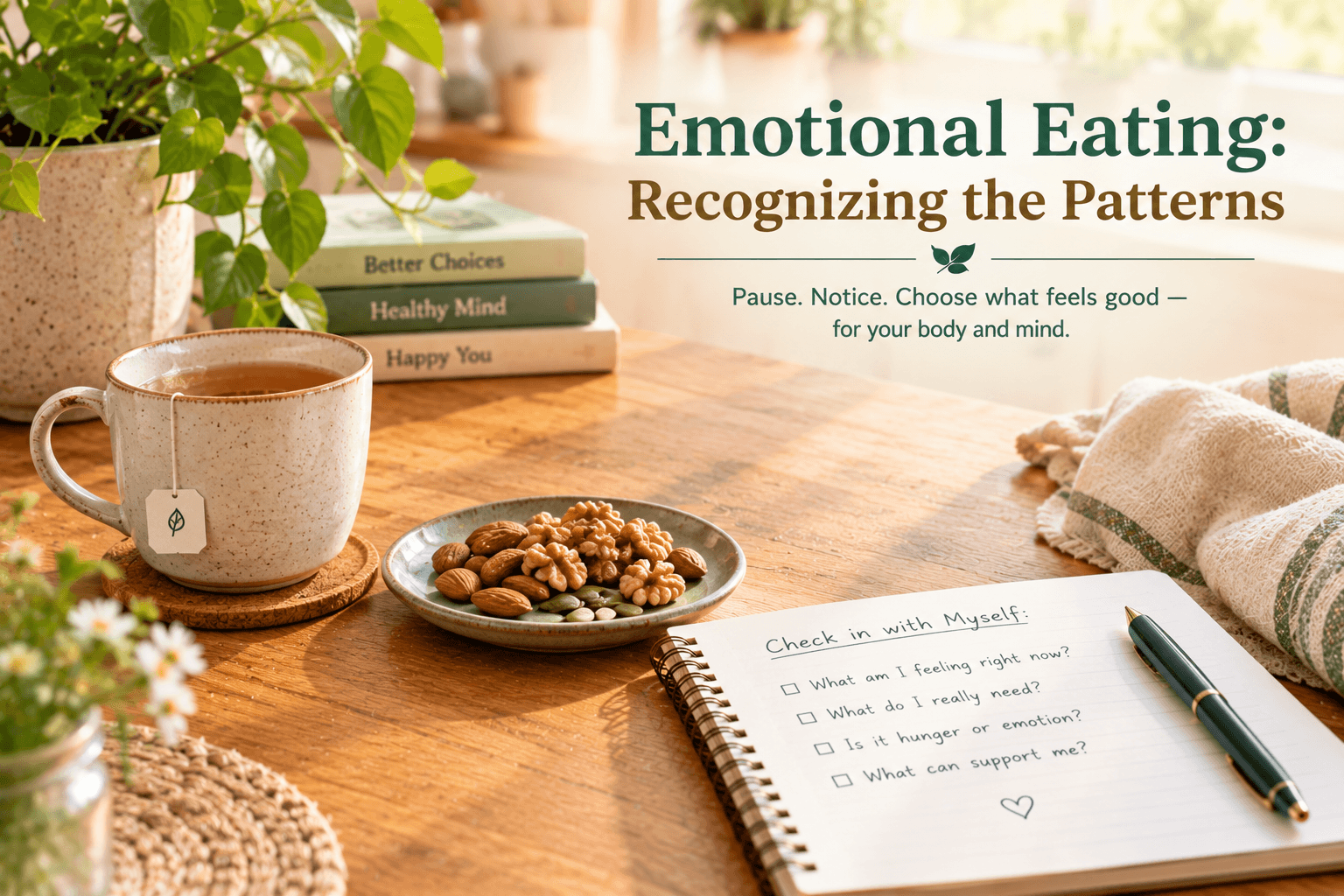
3. Pause and Ask
When an urge appears, try a short pause of a few minutes. Ask yourself:
- When did I last eat?
- Am I physically hungry, or is it something else?
- What am I feeling right now?
- What do I actually need: food, rest, company, a break, comfort?
Sometimes the urge fades during the pause, and sometimes you decide to eat anyway, which is perfectly fine. The point is to make it a choice rather than an autopilot response.
4. Try a Different Response Sometimes
If you are not physically hungry, consider other ways to meet the need underneath:
- Stressed: A few slow breaths, a short walk, stretching, or stepping outside for fresh air.
- Bored: A call to a friend, a hobby, music, tidying a drawer, or a short errand.
- Lonely or sad: Reach out to someone, share how you feel, or write it down.
- Tired: A short nap, an earlier bedtime, or simply rest.
- Anxious: Pranayama, meditation, or grounding exercises.
You do not need to avoid food entirely. The aim is to widen your options so that eating is one of many ways of coping, not the only one.
5. Practise Mindful Eating
Mindful eating means paying attention while you eat, noticing taste, texture, and your body’s signals, and eating without distractions. Research is encouraging, if modest. In one randomised trial, people who started out higher in compulsive eating seemed to benefit more from a mindful eating programme than from other approaches, and the researchers suggested that those with higher levels of these behaviours may be better suited to this kind of training. Not every study shows big weight changes, and mindfulness is best thought of as a way of changing your relationship with food, not as a quick route to a number on the scale.
- Sit down to eat, ideally without a phone or TV.
- Take a few breaths before the first bite.
- Eat slowly, and put down your spoon between bites.
- Check in halfway through: How does it taste? Am I still hungry?
- Stop when you feel comfortably satisfied, not stuffed.
6. Make Your Environment Work for You
- Keep a variety of nourishing snacks within easy reach, such as fruit, roasted chana, nuts, and curd.
- Keep very tempting foods out of sight, but avoid labelling foods as “forbidden,” which can make them more tempting.
- Portion snacks into a bowl rather than eating from the packet.
- Stay away from the kitchen when you are not there to eat, especially when working from home.
7. Look After Sleep, Movement, and Stress
Good sleep, regular movement, daylight, and genuine downtime reduce the pressure that drives emotional eating. As our articles on stress, cortisol, and heart health and on sleep and memory explained, stress and poor sleep affect the body in many ways, including appetite and mood.
8. Be Kind to Yourself
Guilt and harsh self-talk tend to fuel the cycle, since feeling bad is itself an emotion that can trigger more eating. Treat slips the way you would treat a friend’s: with understanding. Ask what you can learn, and move on. Progress is not a straight line.
9. Get Support
Talk to a trusted friend or family member, join a support group, or see a professional. Evidence-based talking therapies, delivered by a trained clinician, help many people with emotional or binge eating. A dietitian can help you build a regular, balanced way of eating without the extremes of dieting.
A Note About Weight and Dieting
This article sits in our weight management series, but it is worth saying clearly: for many people, the way out of emotional eating is not a stricter diet. Rigid rules, skipped meals, and constant self-monitoring can make eating more fraught, not less. Focusing on regular meals, a varied diet, movement you enjoy, good sleep, and managing stress usually serves both emotional wellbeing and long-term health better than a strict plan. If weight is a health concern for you, a doctor or dietitian can help you approach it in a way that does not make your relationship with food worse. And if you feel your thoughts about food, weight, or body shape have taken over, please speak to a professional.
Emotional Eating in Indian Homes and Festivals
- Festival foods. Enjoy the mithai, the pakwan, and the family recipes. Eating special foods at special times is part of life. Try regular meals around the feasting so that you arrive at the table calm rather than ravenous, and eat slowly enough to taste what you love.
- Fasting and feasting cycles. Long fasts followed by heavy meals can feel like a restrict-and-rebound pattern for some. If you fast, break it gently, and speak to your doctor if you have diabetes, a heart condition, or are pregnant or breastfeeding.
- Family hospitality. It is okay to say “I’m full, thank you” or to ask for a small portion. You can show appreciation without clearing your plate. Many hosts are just as happy with warm words as with empty plates.
- Comments about food and bodies. If relatives comment on what you eat or how you look, remember that you do not have to engage. A calm “I’m fine, thanks” or changing the subject is enough, and you can ask family to be considerate, especially around children and teenagers.
- Exam and work stress. Plan nourishing snacks and breaks in advance, so that late-night studying or work does not rely on whatever is in the cupboard.
- Chai and snack rituals. You can keep the ritual and still choose what goes with it, such as roasted makhana or nuts with your chai.
- Work from home. Create a boundary between work and kitchen, schedule real lunch breaks, and step outside once in a while.
The Ayurvedic Perspective: Eating With Awareness
Ayurveda has long recognised the connection between the mind and digestion. Traditional texts describe how emotions such as worry, grief, fear, and anger can disturb Agni, the digestive fire, and affect appetite and digestion. In this tradition, caring for how you eat is as important as what you eat.
Ahara Vidhi: The Way of Eating
Classical guidance on eating (Ahara Vidhi) offers a surprisingly modern checklist. It advises eating warm, freshly prepared food in an appropriate quantity, only when the previous meal has been digested, in a pleasant and calm place, without eating too fast or lingering too long, and without being distracted by talking or laughing, but with full attention on the meal. This lines up closely with what we now call mindful eating.
Mind and Constitution
Ayurveda also links patterns of eating with a person’s constitution and current state:
- Vata imbalance is associated with anxiety, restlessness, and irregular eating, such as skipped meals followed by grazing. Regular routine, warm meals, and calming practices are traditionally recommended.
- Pitta imbalance is associated with irritability and intensity, and a tendency to eat quickly or in anger. Cooling, calm, unhurried meals are traditionally advised.
- Kapha imbalance is associated with low mood, heaviness, and seeking comfort in sweet or heavy food. Gentle activity, lighter meals, and stimulation are traditionally recommended.
These are traditional frameworks and not diagnoses, and an Ayurvedic practitioner can help interpret them for you.
Traditional Supports for a Calmer Mind and Gut
- A steady daily routine (Dinacharya): Regular meal and sleep times are believed to settle both the mind and digestion.
- Pranayama and meditation: Slow breathing practices, such as Anulom Vilom and Bhramari, are traditionally used to calm the mind. They can be a handy alternative to eating when a stress urge arises.
- Warm oil massage (Abhyanga): Traditionally used for relaxation and grounding.
- Digestive spices and warm drinks: Cumin, fennel, ajwain, ginger, and tulsi tea are traditionally used to support digestion and are a comforting, warm alternative to a snack.
- Herbs for the mind: Ashwagandha and Brahmi are traditionally used to support calm and mental clarity. As we noted in our adaptogens article, the evidence is modest and mixed, so they are best treated as optional extras and discussed with a doctor first.
The shared message between tradition and modern research is the same: slow down, eat with attention, keep a steady rhythm, and care for the mind as well as the stomach.
Common Myths About Emotional Eating
- Myth: Emotional eating means you have no willpower. It is a learned coping habit shaped by biology, environment, and experience, and willpower is only part of the picture.
- Myth: You should never eat for comfort. Food is part of comfort, culture, and connection. The aim is flexibility, not never eating for emotional reasons.
- Myth: A stricter diet will fix it. Rigid rules can make cravings and rebound eating worse.
- Myth: Emotional eating only affects people who are overweight. People of all body sizes can eat emotionally.
- Myth: Emotional eating and binge eating disorder are identical. They overlap, but binge eating disorder involves recurrent loss-of-control episodes with significant distress and needs professional care.
- Myth: Feeling guilty helps you stop. Guilt tends to make the cycle worse. Self-compassion is more helpful.
- Myth: You can just distract yourself with something healthy every time. Sometimes you need rest, company, or comfort, and sometimes food is okay too.
Frequently Asked Questions
1. What is emotional eating?
Emotional eating is eating in response to feelings such as stress, boredom, sadness, or loneliness, rather than physical hunger. It is common and is generally understood as a learned way of coping, reinforced because food can bring brief relief.
2. How can I tell if I am hungry or eating emotionally?
Physical hunger usually builds gradually, is open to many foods, shows up in the body, and stops when you are full. Emotional hunger often arrives suddenly, craves a specific comfort food, can occur right after a meal, and may continue past fullness or lead to guilt. In practice the two can overlap, so curiosity matters more than getting it exactly right.
3. Is emotional eating the same as binge eating disorder?
No. Binge eating disorder is a recognised condition involving recurrent episodes of eating a large amount of food with a feeling of loss of control and significant distress. A qualified clinician can make that diagnosis. If you feel out of control around food, please speak to a doctor or mental health professional.
4. Will dieting stop emotional eating?
Often it does not. Strict diets, skipped meals, and forbidden-food rules can make cravings stronger and lead to rebound eating. Regular, balanced meals, sleep, stress management, and mindful eating tend to be more helpful, ideally with guidance from a dietitian or professional.
5. When should I get professional help?
Seek support if you regularly eat large amounts with a feeling of being unable to stop, hide your eating, feel intense guilt or distress, use vomiting, laxatives, fasting, or excessive exercise to compensate, or feel low or hopeless. In India, Tele-MANAS (14416) offers free, confidential support, and in an emergency you can call 112.
A Gentle Note Before You Go
Recognising your patterns is a quiet act of self-understanding, and it is the foundation of every other change. Be patient with yourself, and give yourself the same kindness you would offer a friend. If you are looking for gentle, everyday support alongside a balanced routine, Healthywe’s range of weight management herbal supplements is made using 100% natural, vegetarian ingredients rooted in traditional Ayurvedic wisdom. Please note that supplements cannot address emotional eating, and if you suspect disordered eating, speak to a doctor before using any product.
As always, lifestyle changes and herbal supplements are meant to support your overall wellness, not replace medical or mental health care. Please consult your doctor or an Ayurvedic practitioner for proper diagnosis, and before making any changes to a prescribed treatment.
Explore our natural wellness range at www.healthywewellness.com/shop.