Quick Answer
The main difference in constipation vs IBS is pain. Functional constipation is mainly about difficult, infrequent, or incomplete bowel movements, with hard or lumpy stools and straining. Irritable bowel syndrome (IBS) is a gut-brain condition in which recurrent abdominal pain, at least one day a week over three months, is linked to bowel movements and comes with a change in how often you go or what your stool looks like. IBS can show up as constipation (IBS-C), diarrhoea (IBS-D), or a mix of both (IBS-M). The two overlap a great deal, symptoms can shift from one to the other over time, and a doctor is the right person to tell them apart. Fibre, fluids, regular toilet habits, movement, and stress management help many people with either, and certain “red flag” symptoms, such as blood in the stool, unexplained weight loss, or anaemia, always need a medical check. This is general wellness information, not medical advice.
Almost everyone has been constipated at some point, and almost everyone has had a stomach that cramps and rumbles when they are stressed. When both happen together, or when constipation keeps coming back with belly pain and bloating, a common question is whether it is “just constipation” or something called IBS. In this article we will explain the difference between constipation and IBS in simple terms, look at how doctors tell them apart, what guidelines suggest for managing each, which signs mean you should not wait, and what Ayurveda has traditionally said about sluggish and unsettled digestion.
Why Constipation and IBS Get Mixed Up
Both conditions involve a change in how your bowels work, and both are very common. Both can cause bloating, a feeling of heaviness, and a sense that you have not fully emptied your bowels. Both are described as “functional” disorders, which means they are diagnosed from your pattern of symptoms rather than from a visible damage or abnormality on routine tests. Both are also affected by diet, stress, sleep, and routine.
The confusion is made worse by the fact that IBS can itself present mostly as constipation. Doctors call that form IBS with constipation, or IBS-C. So it is not a question of “constipation or IBS” in every case. Sometimes the real question is “is my constipation on its own, or is it part of IBS?” That is exactly what the pain pattern helps to answer.
What Is Constipation?
Constipation means that bowel movements are infrequent, difficult, or unsatisfying. It is not only about how often you go. Many people think they must go every day, but a healthy pattern varies from person to person. What matters is whether your usual pattern has become harder or less comfortable.
The Rome IV Description of Functional Constipation
Doctors often use a set of symptom-based criteria called Rome IV to define functional constipation. To meet them, a person must have two or more of the following in the last three months, with symptoms starting at least six months earlier:
- Straining during more than a quarter of bowel movements
- Lumpy or hard stools (types 1 or 2 on the Bristol Stool Scale) in more than a quarter of bowel movements
- A feeling of incomplete emptying in more than a quarter of bowel movements
- A sensation of a blockage in the lower bowel in more than a quarter of bowel movements
- Needing hands or other manoeuvres to help in more than a quarter of bowel movements
- Fewer than three spontaneous bowel movements a week
In addition, loose stools should rarely occur without the use of laxatives, and the person should not meet the criteria for IBS. Note how the list focuses on difficulty and frequency, not on pain.
The Bristol Stool Scale
This is a simple picture chart that groups stools into seven types. Types 1 and 2 are separate hard lumps or a lumpy sausage, which suggest constipation. Types 3 and 4 are the smooth or cracked sausage shapes that are generally regarded as normal. Types 6 and 7 are mushy or watery, which suggest loose stools. Looking at your stool and comparing it with the chart can help you describe your pattern clearly to a doctor.
What Is IBS?
Irritable bowel syndrome is a common disorder of gut-brain interaction. It is called functional because the gut looks normal on routine tests, but it does not work normally: the gut may be more sensitive, move differently, or respond more strongly to stress and food. IBS is not a sign that something is “wrong with your character” or that you are imagining it. The symptoms are real.
The Rome IV Criteria for IBS
According to the Rome IV criteria, IBS means recurrent abdominal pain, on average at least one day a week over the last three months, that is associated with two or more of the following:
- It is related to defecation (it may get better or worse after a bowel movement)
- It comes with a change in how often you pass stool
- It comes with a change in how your stool looks (its form)
These symptoms should have started at least six months before diagnosis. The key word is pain. Under the older Rome III criteria, discomfort counted. Under Rome IV, abdominal pain is required for an IBS diagnosis, which sharpened the line between IBS and simple constipation or simple diarrhoea.
The Four IBS Subtypes
IBS is grouped by the kind of stools you mostly have:
- IBS-C: more than a quarter of stools are hard or lumpy, and fewer than a quarter are loose or watery.
- IBS-D: more than a quarter of stools are loose or watery, and fewer than a quarter are hard or lumpy.
- IBS-M (mixed): both hard and loose stools occur more than a quarter of the time.
- IBS-U (unsubtyped): the person meets IBS criteria, but the stool pattern does not fit the others.
Because IBS-C is one of these subtypes, it is the one most likely to be confused with ordinary constipation.
The Key Difference: Pain
If you remember only one thing from this article, remember this: according to the Rome criteria, recurrent abdominal pain, together with its link to bowel movements, is the main way to separate IBS with constipation from functional constipation. A scoping review of clinical guidelines found that abdominal pain is emphasised in IBS-C definitions but is not part of the definitions of functional constipation, while the number of spontaneous bowel movements is commonly used to define constipation but is not used in IBS-C definitions.
The Rome Foundation also describes functional bowel disorders as lying on a spectrum. When there is little or no pain, a person is more likely to have functional constipation or functional diarrhoea. When pain is greater and more regular, IBS becomes more likely.
The Pain Link Is Not Always Clear-Cut
It would be too simple to say that constipation is painless and IBS is painful. People with ordinary constipation can have belly aches, especially when they are backed up. And the amount of pain in both IBS-C and functional constipation can change over time. If someone has abdominal pain less than once a week, they would not be classed as IBS under the criteria, even if they have occasional pain. So the boundary is a practical rule that doctors use, not a sharp biological wall.
A helpful clue is what happens to the pain when the stool moves. In children, for example, the Rome IV criteria say that if pain goes away when constipation is resolved, it is functional constipation rather than IBS. In adults too, pain that clearly eases once the bowels are cleared suggests the constipation is the main problem, while pain that continues or comes and goes with changing stool patterns points more towards IBS.
Constipation vs IBS: A Side-by-Side View
- Main problem: Constipation is difficult, infrequent, or incomplete passage of stool. IBS is recurrent abdominal pain linked with bowel changes.
- Abdominal pain: Not required for constipation. Required for IBS, at least one day a week on average.
- Pain and bowel movements: In IBS, pain is related to defecation (it may ease or worsen). In constipation, pain, if present, is usually from being backed up.
- Stool pattern: Constipation: hard, lumpy stools and straining. IBS-C: hard stools too, but IBS may also bring loose stools (IBS-M) or mainly loose stools (IBS-D).
- Bloating: Common in both, though often more prominent and variable in IBS.
- Frequency criteria: Fewer than three spontaneous bowel movements a week is one of the constipation criteria. Bowel frequency is not used to define IBS-C.
- How it behaves over time: Constipation is often steadier. IBS tends to come and go, flare with stress or certain foods, and may change between subtypes.
- Relief from going: Many people with IBS feel some relief after a bowel movement, though in others pain gets worse.
Can You Have Both?
Yes, and it is common. A person may start with simple constipation and later develop pain that fits IBS-C. Others may have IBS-C that shifts over the years towards a mixed pattern, or have simple constipation at one time and IBS at another. The Rome Foundation has itself acknowledged that there is overlap between the diagnoses and that people can move between them. This is one more reason not to worry about getting the label exactly right on your own. The aim is to understand your pattern and find strategies that suit you.
Common Causes and Triggers of Constipation
For constipation on its own, a number of everyday factors are involved:
- Too little fibre: Diets heavy in refined flour, white rice, and packaged snacks and light in vegetables, fruit, whole grains, and legumes.
- Too little fluid: Fibre needs water to work properly.
- Ignoring the urge: Delaying the toilet because you are busy, travelling, or uncomfortable using public facilities.
- Little physical activity: Movement helps the gut move.
- Changes in routine: Travel, shift work, and irregular meals.
- Some medicines and supplements: Certain iron and calcium supplements, some painkillers, and some other medicines can slow the bowels. Never stop a prescribed medicine on your own, but do mention constipation to your doctor.
- Pregnancy: Hormonal changes slow digestion.
- Medical conditions: Such as an underactive thyroid or diabetes, which a doctor can check.
- Pelvic floor problems: In some people, the muscles that control the passage of stool do not coordinate properly, making it hard to empty the bowels even though the stool itself is not hard.
- Stress and low mood: Which can change gut movement.
What Lies Behind IBS?
IBS has no single cause. Experts describe it using a biopsychosocial model, meaning that biology, mind, and life circumstances all play a part. Factors commonly discussed include:
- Gut-brain communication: The gut and brain talk to each other all the time through nerves and hormones, and in IBS this signalling can be more sensitive.
- Gut sensitivity: Normal gas or stretching in the gut may be felt as pain.
- Altered gut movement: The gut may move too slowly (leading to constipation), too quickly (leading to loose stools), or unevenly.
- Gut microbes and low-grade inflammation: Changes in the gut microbial community and subtle immune activation have been studied.
- Diet: Certain foods trigger symptoms in some people.
- Stress and mood: Stress hormones affect gut movement, pain sensitivity, and the gut barrier.
- Past infections and genetics: IBS is more common in people with a family history, and some people develop it after a stomach infection.
Red Flags: Symptoms That Should Not Wait
Most constipation and most IBS are not dangerous, but a few symptoms can point to other conditions that need proper tests. Guidelines list these “alarm features”:
- Blood in the stool, or rectal bleeding
- Black, tarry stools
- Unintentional weight loss
- Anaemia, especially iron-deficiency anaemia
- New symptoms starting at age 45 or older
- A family history of colon cancer, inflammatory bowel disease, or another significant digestive disease
- Persistent vomiting
- Difficulty swallowing
- A lump or mass felt in the abdomen
- Symptoms that wake you from sleep or are rapidly getting worse
- A sudden, lasting change in bowel habit that is unlike your normal pattern
Having one of these does not mean you have a serious illness, and researchers note that alarm features are quite common and are an imperfect guide. But the likelihood of an organic cause rises as the number of alarm features increases, so they are a clear signal to see a doctor and not to rely on home remedies or self-diagnosis.
How Doctors Approach the Question
A good doctor will start by listening carefully. They will ask how often you go, what your stools look like, whether you have pain and how it relates to bowel movements, how long it has been going on, what you eat, what medicines you take, and what stress or life events surround it. Guidelines from the American College of Gastroenterology support a “positive diagnostic strategy” for IBS, meaning that the diagnosis is made from the symptom pattern with limited testing, rather than only after ruling everything else out. The same guideline advises against routine colonoscopy for people under 45 with IBS symptoms and no alarm features.
For people with constipation that does not respond to usual measures, or with signs suggesting a pelvic floor problem, doctors may consider specialised tests of how the rectum and anus work. A doctor may also order blood tests or other checks depending on your symptoms and risk factors. The details differ from person to person, which is why professional assessment matters.
Self-Care That Helps Both Conditions
Many everyday habits help whether you have simple constipation, IBS-C, or something in between. They are most effective when introduced gradually and kept up.
Build Up Fibre Slowly
Fibre adds bulk and softness to stool. Increase it over a couple of weeks rather than overnight, and drink enough water, because a sudden jump in fibre can cause gas and bloating. Common guidance suggests an overall fibre intake in the region of 20 to 35 grams a day for most adults, but your doctor or dietitian can tailor this.
Drink Enough Fluids
Water, buttermilk, soups, and unsweetened drinks all count. Fibre without enough fluid can make constipation worse.
Respect Your Body’s Signals
When you feel the urge, go. Do not hold it for hours. Many people find that the best time is after a meal, especially breakfast, when the gut naturally becomes more active.
Set Up a Calm Toilet Routine
- Allow unhurried time, but avoid sitting for long or straining.
- Try raising your feet on a small stool so your knees sit above your hips, which many people find makes it easier.
- Leave your phone outside the toilet.
- Breathe slowly, relax your belly, and do not push hard.
Keep Moving
Regular walking, yoga, and other activity help the gut move. Even a short walk after meals can help.
Eat at Regular Times
A predictable eating pattern helps train a predictable bowel rhythm.
Look After Sleep and Stress
Poor sleep and ongoing stress can worsen both constipation and IBS. Breathing practices, meditation, gentle yoga, time in nature, and talking to someone you trust all help the gut-brain connection.
What Guidelines Say About IBS Management
For IBS specifically, a few approaches have the support of major guidelines, and it helps to know how strong that support is.
- Soluble fibre. The American College of Gastroenterology gives a strong recommendation for soluble, but not insoluble, fibre for overall IBS symptoms, with moderate-quality evidence. Soluble fibre is found in psyllium (ispaghula or isabgol husk), oat bran, barley, and beans. The Canadian Association of Gastroenterology also recommends psyllium for IBS symptoms. Insoluble fibre, such as wheat bran, did not show a significant benefit in the research reviewed, and may worsen bloating in some people.
- A limited trial of a low FODMAP diet. FODMAPs are a group of fermentable carbohydrates that can cause gas and discomfort in sensitive guts. Guidelines suggest a short, structured trial, ideally guided by a trained dietitian, because the evidence quality is low to very low and the diet is restrictive and not meant to be followed strictly forever.
- Peppermint oil. Guidelines suggest it may help overall symptoms and abdominal pain, though the evidence is rated low quality. It is generally well tolerated but can cause heartburn or belching in some people. Please check with your doctor before using it, especially if you have reflux.
- Probiotics. Major guidelines have been cautious about recommending particular probiotic products for IBS because results vary by strain and study. If you are interested, our article on probiotics and prebiotics explains how to think about them.
These are general points, not personal advice. A doctor can help decide which options suit you and whether other approaches, such as medicines, psychological therapies, or pelvic floor retraining, might help.
Foods and the Indian Plate
Indian food offers many fibre-rich options, but the “right” choices depend on whether you have simple constipation or IBS.
- Helpful for many people with constipation: whole wheat roti, millets such as ragi, bajra, and jowar, oats, dalia, vegetables, fruit such as papaya, guava, and pear, soaked prunes or figs, and plenty of water or buttermilk.
- Soluble fibre sources: isabgol (psyllium husk), oats, barley (jau), and well-cooked beans and lentils. Isabgol is usually taken with plenty of water, and it is wise to start with a small amount.
- Possible triggers for sensitive IBS guts: onion, garlic, some dals and beans, wheat in large amounts, very spicy or fried foods, carbonated drinks, and large amounts of sweeteners. These affect people differently, and many people with IBS can still enjoy them in small portions.
If you suspect specific foods, keeping a simple diary of what you eat and how you feel for two to three weeks can be more informative than cutting out many foods at once. Dropping lots of foods without guidance can leave your diet unbalanced.
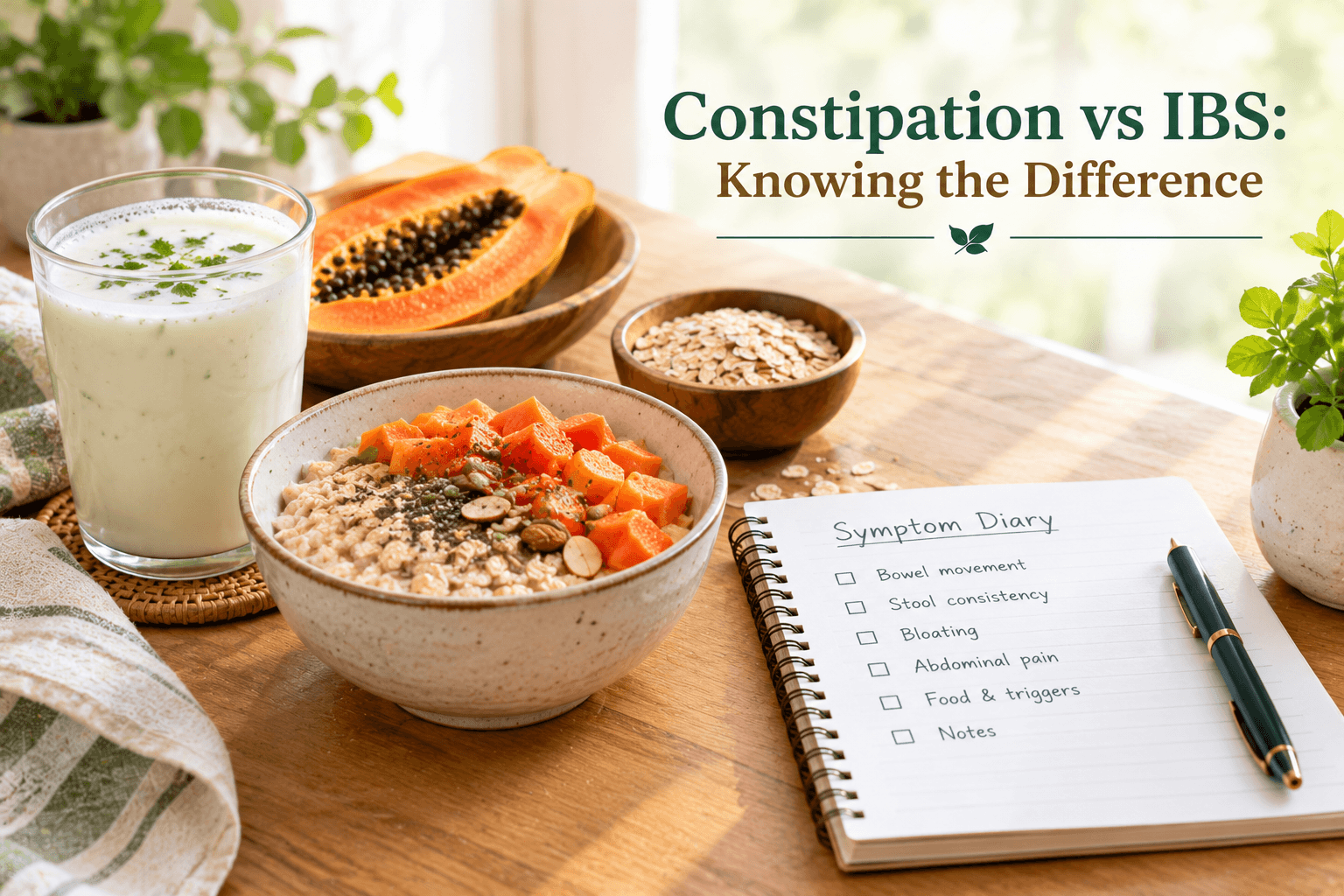
Keeping a Symptom Diary
A diary makes your doctor’s visit much more useful. For a couple of weeks, note down:
- How many times you go each day, and when
- The Bristol type of your stool
- Any abdominal pain, how strong it is, and whether it changes after a bowel movement
- Bloating, gas, or a feeling of incomplete emptying
- What you eat and drink, and your fluids
- Your stress levels, sleep, and any medicines or supplements
- Your menstrual cycle, if relevant, since symptoms can vary with it
The Ayurvedic Perspective on Constipation and Irritable Digestion
Ayurveda has long been interested in the regularity of the bowels, which it sees as a sign of the health of digestion and of the whole body.
Vibandha, Udavarta, and Vata
Constipation is traditionally called Vibandha, and a related condition in which the downward movement of wind (Apana Vata) is obstructed, causing a feeling of pressure, bloating, and discomfort, is called Udavarta. Ayurveda links these mainly to aggravated Vata dosha, which has qualities of dryness, lightness, and coldness, and which governs movement in the body, including the movement of stool. A dry, cold, irregular lifestyle and diet are traditionally believed to aggravate it.
Grahani and the Role of Agni
Another traditional concept is Grahani, which refers to the part of the digestive system where food is held, digested, and sorted. A disturbance of Agni (digestive fire) in this region is traditionally described in classical texts as causing irregular bowel habits, sometimes constipation, sometimes loose stools, along with heaviness, gas, and discomfort. Some practitioners compare this picture with IBS, but the match is approximate, since Ayurveda and modern medicine describe the body in different languages. Traditional texts also note that worry, grief, fear, and irregular routines can disturb digestion, which echoes what modern research says about stress and the gut.
Traditional Approaches
- Warm, freshly cooked, mildly oily food: Such as khichdi, soups, and vegetables cooked with a little ghee, which are traditionally considered gentle on Agni and soothing for Vata.
- Warm water through the day: Traditionally recommended to support digestion and regularity.
- Regular meal and sleep times: Part of Dinacharya, the daily routine, believed to settle Vata.
- Avoiding very dry, cold, stale, or heavily processed foods.
- Digestive spices: Cumin, fennel, ajwain, ginger, and hing are traditionally used to support digestion and ease gas.
- Triphala: A classical combination of three fruits traditionally used to support regularity and digestive health. As with any herbal product, ask an Ayurvedic practitioner or your doctor, particularly if you are pregnant, breastfeeding, or taking medicines.
- Abhyanga (warm oil massage) and gentle yoga: Traditionally used to calm Vata and support relaxation and movement.
- Buttermilk (takra): A light fermented drink traditionally valued for digestive comfort.
The Ayurvedic emphasis on routine, warmth, calm, and balanced, freshly prepared food fits comfortably with modern advice for both constipation and IBS. It is also worth saying that Ayurveda sees digestive problems as signals to look at the whole person, which is a useful reminder not to focus on bowel habits alone but also on sleep, stress, and emotional wellbeing. In Ayurveda, digestion, the liver, and the metabolism of bile are also seen as closely related, which is part of why digestive and liver care are often discussed together.
Special Situations: Women, Pregnancy, and Older Adults
Women and Hormonal Changes
Many women notice that bowel habits change around their periods, with more constipation, bloating, or loose stools at certain points in the cycle. IBS is reported more often in women, and symptoms may flare with hormonal shifts. If your symptoms follow a monthly pattern, mention this to your doctor and note the dates in your symptom diary, since it can help explain what is going on.
Pregnancy
Constipation is very common in pregnancy because hormones slow digestion and a growing womb presses on the bowels, and some iron supplements add to the problem. Fibre, fluids, and gentle movement are the usual first steps, but pregnancy is a time to check with your doctor before taking any laxative, fibre supplement, or herbal product. Straining can also contribute to piles, so addressing constipation early is worthwhile.
Older Adults
Constipation becomes more common with age, partly because of reduced activity, changes in diet and fluid intake, and the number of medicines older people take. At the same time, new bowel symptoms starting at 45 or older are listed among the alarm features, so a new or changing pattern in an older adult should be checked by a doctor rather than assumed to be age-related. If you care for an older family member, watch for reduced appetite, weight loss, blood in the stool, or sudden changes in bowel habit, and encourage a medical visit.
Children and Teenagers
Children can also have constipation, often linked to holding stools, toilet fears, or low fibre intake. IBS can occur in young people too. Children should be assessed by a paediatrician before any laxative or supplement is used, and please do not give adult products to a child.
Common Myths About Constipation and IBS
- Myth: You must go every single day. Normal patterns vary. What matters is a change from your usual pattern, or difficulty and discomfort.
- Myth: IBS is “all in the mind.” IBS is a real disorder of gut-brain interaction, with changes in sensitivity and movement. Stress can worsen it, but it does not mean the symptoms are imagined.
- Myth: Bran and more fibre are always the answer. Soluble fibre appears more helpful than insoluble fibre for IBS, and too much too quickly can cause gas and bloating.
- Myth: Daily strong laxatives are a safe long-term fix. Regular use of laxatives without medical advice is not a good idea. If you need them often, see a doctor to look for the cause.
- Myth: If you have IBS, you will eventually get a serious disease. IBS does not by itself lead to cancer, but red-flag symptoms always need checking, because other conditions can occur in anyone.
- Myth: A cleanse or detox will reset your gut. The gut does not need dramatic cleanses, and extreme approaches can cause harm. Steady habits work better.
- Myth: Everyone with IBS must follow a strict diet forever. Elimination diets are meant to be short, structured trials, with foods reintroduced to find your personal triggers.
Questions Worth Asking Your Doctor
- Do my symptoms fit constipation, IBS, or a mixture, and how can you tell?
- Do I have any red-flag features that need tests?
- Could any of my medicines or supplements be contributing?
- Should my thyroid, blood count, or other things be checked?
- Would a dietitian or a pelvic floor specialist help me?
- How much fibre and fluid should I aim for, and which kind?
- When should I come back if I am not improving?
Setting Realistic Expectations
Bowel habits rarely change overnight, so give any new routine a fair trial of a few weeks before judging it. Constipation often improves steadily once fibre, fluids, movement, and toilet habits are in place, while IBS tends to be a long-term condition with ups and downs, where the aim is to understand your triggers and keep symptoms manageable rather than to aim for perfection. Good days and bad days are normal. What matters is the overall direction: more comfort, more predictability, and more confidence about what to do when symptoms flare. If you are not seeing progress, that is useful information for your doctor, not a personal failure, and a change of approach may help.
Frequently Asked Questions
1. What is the main difference between constipation and IBS?
Constipation is mainly about difficult, infrequent, or incomplete bowel movements, while IBS involves recurrent abdominal pain, at least one day a week on average, linked to bowel movements and a change in stool frequency or form. IBS can present mostly as constipation (IBS-C), which is why the two are often confused, and a doctor can help tell them apart.
2. Can constipation turn into IBS?
The two can overlap, and people can move between them over time. Someone with ongoing constipation may later develop pain that fits the criteria for IBS with constipation. If your constipation is now accompanied by regular abdominal pain, it is worth discussing this with your doctor.
3. When should I see a doctor about constipation or bowel changes?
See a doctor if you notice blood in the stool, black stools, unexplained weight loss, anaemia, persistent vomiting, difficulty swallowing, a lump in the abdomen, a family history of colon cancer or inflammatory bowel disease, or new symptoms after the age of 45. Also see a doctor if symptoms are severe, getting worse, or lasting more than a few weeks despite simple measures.
4. Is fibre good for IBS?
Soluble fibre, found in psyllium, oat bran, barley, and beans, is recommended by major guidelines for overall IBS symptoms, while insoluble fibre such as wheat bran has not shown the same benefit and may worsen bloating in some people. Increase fibre gradually, drink enough water, and ask your doctor or dietitian what suits you.
5. Do I need a colonoscopy to diagnose IBS?
Not usually. The American College of Gastroenterology advises against routine colonoscopy for people under 45 with IBS symptoms and no alarm features. Whether you need tests depends on your age, symptoms, and risk factors, which your doctor can assess.
A Gentle Note Before You Go
Knowing the difference between constipation and IBS can make it easier to describe your symptoms, choose helpful habits, and recognise when it is time to ask for help. If you are looking for gentle, everyday support alongside a fibre-rich diet and a steady routine, Healthywe’s range of digestive and liver care herbal supplements is made using 100% natural, vegetarian ingredients rooted in traditional Ayurvedic wisdom.
As always, dietary changes and herbal supplements are meant to support your overall wellness, not replace medical care. Please consult your doctor or an Ayurvedic practitioner for proper diagnosis, and before making any changes to a prescribed treatment.
Explore our natural wellness range at www.healthywewellness.com/shop.