Quick Answer
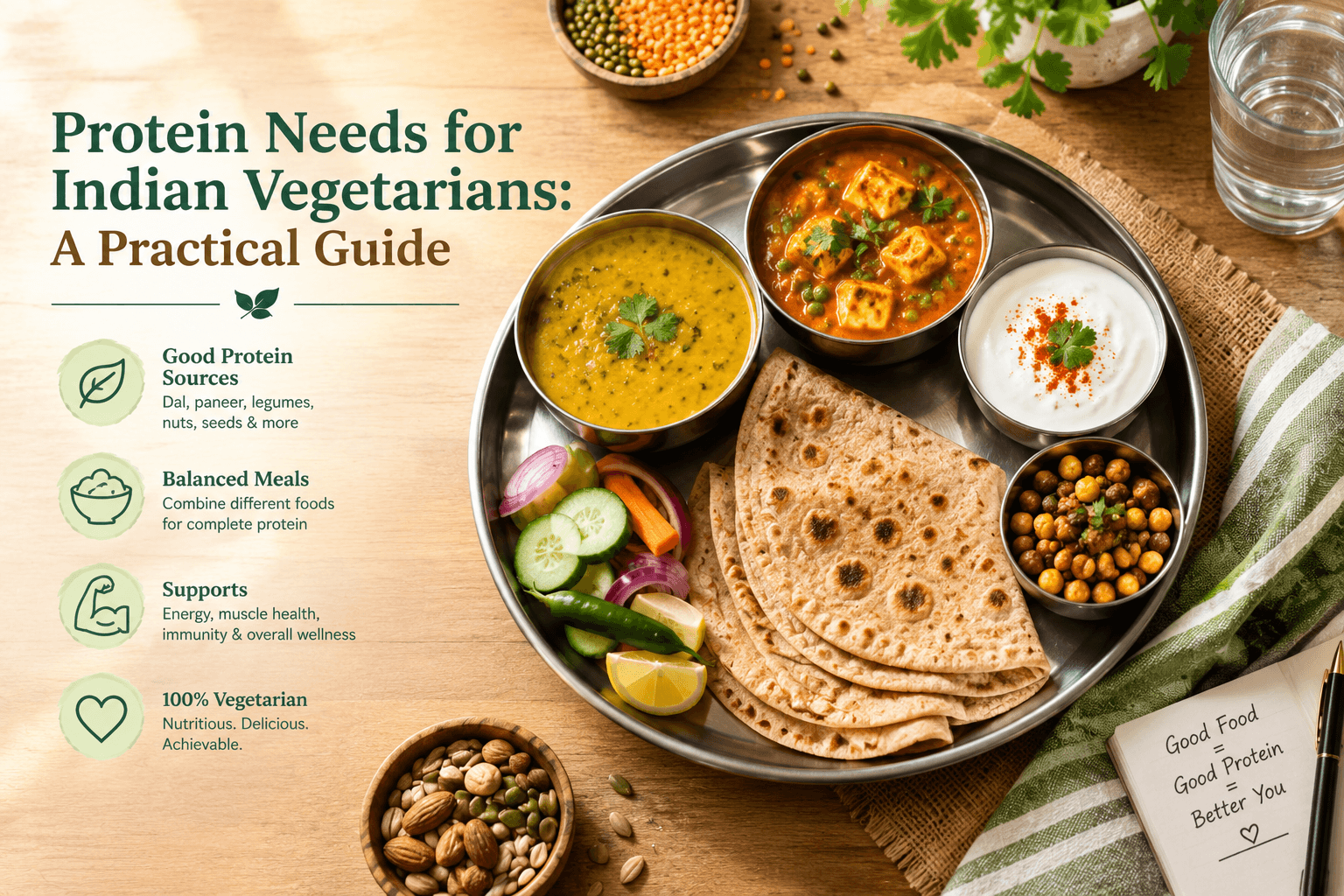
According to the ICMR-NIN 2020 guidelines, protein needs for Indian vegetarians start at a safe daily intake of 0.83 grams per kilogram of body weight for healthy, sedentary adults, meaning roughly 50g daily for a 60kg person, rising to 1.0-1.4g per kg for physically active people, and adjusted further for growth, pregnancy, breastfeeding, or older age. The good news is that Indian vegetarian staples like dal, paneer, soy, curd, and legumes can comfortably meet these needs with thoughtful, consistent meal planning. The long-standing idea that plant proteins must be carefully “combined” within the same meal to be useful has been genuinely debunked by decades of nutrition research — what matters is getting a good variety of protein sources across your day, not perfectly pairing them at every single meal. This is general nutrition information, not medical advice — individual protein needs can vary, so please consult a doctor or registered dietitian for guidance specific to your health and goals.
“Where do you get your protein?” is a question nearly every Indian vegetarian has fielded at some point, often with a slightly skeptical tone. The honest, reassuring truth is that a well-planned vegetarian diet, especially a traditional Indian one, can meet protein needs very comfortably. In this article, we’ll walk through protein needs for Indian vegetarians in genuine depth — how much you actually need, which foods deliver it, how to think about protein quality, and what Ayurveda has traditionally taught about building strength through food.
Understanding Your Actual Protein Requirement
Before diving into food sources, it’s worth understanding where the numbers you’ll see throughout this article actually come from. The Indian Council of Medical Research, through its National Institute of Nutrition (ICMR-NIN), published updated Recommended Dietary Allowances in 2020, representing the most current, India-specific nutritional guidance available.
The Baseline RDA
The ICMR-NIN 2020 guidelines set the safe protein requirement at 0.83 grams per kilogram of body weight per day for healthy, sedentary Indian adults. This figure was derived using a median obligatory nitrogen loss calculation, following the WHO’s 2007 methodology, representing the amount of protein needed to prevent deficiency and maintain basic nitrogen balance in the body.
For practical reference, here’s what this translates to for different body weights:
- 50kg adult: Approximately 41.5g protein daily
- 60kg adult: Approximately 50g protein daily
- 70kg adult: Approximately 58g protein daily
- 80kg adult: Approximately 66g protein daily
How Activity Level Changes Your Needs
The baseline RDA assumes a sedentary lifestyle, but your actual needs shift meaningfully with activity level:
- Sedentary work: The baseline 0.83g/kg applies, translating to roughly 43-46g daily for most adults, according to ICMR-NIN’s detailed breakdown by work category.
- Moderate physical activity: Requirements rise, with ICMR-NIN data showing moderate workers needing meaningfully more than sedentary workers.
- Heavy physical work or intense exercise: Can push requirements up to 1.0-1.4g per kg, particularly for athletes, regular gym-goers, or those in physically demanding occupations.
It’s worth noting that some researchers have argued current guidelines may actually be conservative, specifically for people relying heavily on plant-based proteins, suggesting a more appropriate target might be closer to 1g/kg/day given considerations around the digestibility and amino acid profile differences between plant and animal proteins. This is a genuinely reasonable, moderate adjustment to keep in mind, particularly if you’re vegetarian and want to build in a reasonable margin above the bare minimum.
Why the Cereal-Legume-Milk Ratio Matters
ICMR-NIN guidelines specifically note that for good protein quality in an Indian vegetarian diet, the ratio of cereals to legumes to milk should ideally be around 3:1:2.5. This ratio isn’t arbitrary — it reflects decades of nutritional science on how these three food categories complement each other’s amino acid profiles when eaten as part of an overall, varied diet, which is really the foundation of how traditional Indian vegetarian eating patterns have supported adequate protein intake for generations, often without anyone consciously calculating grams.
Why This Topic Deserves Special Attention for Vegetarians
It’s worth being honest about why protein needs for Indian vegetarians get discussed as a distinct topic at all, rather than simply folding into general nutrition advice. The gram-per-kilogram requirement itself doesn’t actually differ between vegetarians and non-vegetarians — your body doesn’t need more total protein just because your sources are plant-based. What genuinely differs is the practical planning involved: vegetarians need to be more deliberate about combining dals, cereals, dairy, nuts, and seeds to ensure both adequate quantity and good quality protein, since many individual plant foods have a less complete amino acid profile on their own compared to many animal protein sources.
Understanding Protein Quality: What “Complete” and “Incomplete” Actually Mean
This is genuinely one of the most important, and most commonly misunderstood, concepts in vegetarian nutrition, so it’s worth unpacking carefully.
The Basics of Protein Quality
Protein is built from 20 different amino acids, nine of which are considered “essential,” meaning your body can’t produce them on its own and must obtain them through diet. A food is generally described as a “complete protein” when it contains all nine essential amino acids in reasonably good proportions. Foods like dairy (paneer, curd, milk), eggs, and soy are considered complete proteins, while foods like most dals, cereals, and nuts are considered “incomplete,” typically because they’re relatively lower in one or two specific essential amino acids, even though they still contain all of them to some degree.
For example, wheat and rice tend to be relatively lower in an amino acid called lysine, while being reasonably good sources of methionine. Dals and legumes tend to be the opposite — relatively higher in lysine, lower in methionine. This complementary relationship is exactly why combinations like dal-chawal (lentils and rice) or dal-roti have formed the backbone of Indian vegetarian eating for so long — they intuitively balance out each other’s amino acid gaps.
The Genuinely Important Myth: Do You Need to Combine Proteins at Every Single Meal?
Here’s where it’s worth being genuinely reassuring, because this is a source of real, often unnecessary anxiety for many vegetarians. The idea that you must carefully combine complementary proteins within the same meal, popularised significantly by a well-known 1971 cookbook, has been substantially revised by subsequent nutrition research. A landmark 1994 review published in the American Journal of Clinical Nutrition concluded clearly that complementary proteins do not need to be consumed at the same meal to be effectively used by the body.
The biological explanation behind this involves what’s sometimes called the body’s “amino acid pool” — your body maintains a circulating pool of free amino acids, drawn from both dietary protein and the ongoing breakdown and recycling of your own body’s proteins, that remains available for building new proteins over a period of time. This means that if you eat dal at lunch and rice at dinner, rather than together in the same meal, your body can still draw on amino acids from both across the day to support complete protein synthesis, rather than requiring them to arrive simultaneously on the same plate.
It’s worth being appropriately balanced here too: this is genuinely the dominant, well-supported scientific consensus, but it’s not entirely without any ongoing discussion in nutrition science — some newer research continues to explore the nuances of protein complementation timing, particularly in specific populations like older adults, where protein metabolism works somewhat differently. For the vast majority of healthy adults eating a reasonably varied diet across the day, though, the practical takeaway is genuinely reassuring: you don’t need to stress about pairing the “right” proteins at every single meal, as long as your overall daily diet includes a good variety of protein sources.
Measuring Protein Quality More Precisely: DIAAS and PDCAAS
For those interested in the more technical side, nutrition science uses scoring systems like PDCAAS (Protein Digestibility Corrected Amino Acid Score) and the newer DIAAS (Digestible Indispensable Amino Acid Score) to quantify protein quality more precisely. Proteins scoring 75 or above on the DIAAS scale are considered high-quality, with scores of 100 or above considered excellent quality. Research has found that certain plant proteins, including soy, along with potato and pea protein, can function as particularly strong “complementary” proteins, meaning they pair especially well with other plant proteins to raise the overall quality of a protein mixture when eaten across meals.
Top Vegetarian Protein Sources for Indians, by Category
Here’s a practical breakdown of protein-dense foods readily available in a typical Indian kitchen, with approximate protein content to help with planning.
Dals and Legumes
- Moong dal: Approximately 24g protein per 100g (raw/dry)
- Masoor dal: Approximately 22-26g protein per 100g (raw/dry)
- Toor dal (arhar): Approximately 21-22g protein per 100g (raw/dry)
- Urad dal: Approximately 22-25g protein per 100g (raw/dry)
- Chana dal: Approximately 21-22g protein per 100g (raw/dry)
- Rajma (kidney beans): Approximately 15g protein per cooked cup
- Chickpeas (chana): Approximately 15g protein per cooked cup
A practical, real-world example: a typical serving of dal-chawal, made with around 50g of dry toor dal and 100g of cooked rice, delivers roughly 18g of combined protein, demonstrating how much a single traditional meal can genuinely contribute toward your daily target.
Soy Products
- Soybeans (cooked): Among the richest plant protein sources available, offering a genuinely complete amino acid profile comparable to animal protein, with high digestibility scores.
- Soy chunks (nutri-nuggets): Particularly concentrated, often cited around 50g+ protein per 100g dry weight, making them an efficient addition to curries and pulao.
- Tofu: A versatile, milder option, typically offering around 8-10g protein per 100g, useful as a paneer alternative for those avoiding dairy.
Soy genuinely stands out in the plant kingdom as one of the few legumes offering a complete amino acid profile on its own, making it a particularly valuable staple for vegetarians, and an especially important one for those who are also dairy-free.
Dairy
- Paneer: Approximately 18g protein per 100g, making it one of the most protein-dense common Indian foods, genuinely comparable to many non-vegetarian options.
- Curd (dahi) and milk: Valuable, easily accessible sources of complete, high-quality protein, alongside calcium and other nutrients.
- Greek-style or hung curd: Often has a notably higher protein concentration than regular curd, due to the straining process removing excess whey.
Nuts and Seeds
- Pumpkin seeds: Approximately 19-25g protein per 100g, along with zinc and magnesium.
- Sunflower seeds: Similarly protein-dense, a genuinely underused option in many Indian diets.
- Peanuts: An accessible, affordable, protein-rich option widely available across India.
- Almonds and other tree nuts: Offer meaningful protein alongside healthy fats, useful as snacks or additions to meals.
Whole Grains and Pseudo-Grains
- Quinoa: One of the few plant foods offering all nine essential amino acids in a reasonably complete profile on its own, with roughly 8g protein per cooked cup.
- Whole wheat and millets: While not complete proteins alone, these contribute meaningfully to overall daily protein intake, particularly when combined with legumes across the day.
Sample Meal Planning: Putting the Numbers Into Practice
Here’s what a genuinely achievable, traditional Indian vegetarian eating pattern might look like in terms of protein contribution, aiming for roughly 50-55g total for the day:
- Breakfast: Moong dal chilla or poha with peanuts, paired with a glass of milk or curd — contributing roughly 12-15g
- Mid-morning snack: A handful of roasted chana or mixed nuts — roughly 6-8g
- Lunch: Dal, roti or rice, a vegetable sabzi, and a small bowl of curd — roughly 18-20g
- Evening snack: Sprouts chaat or a glass of buttermilk — roughly 6-8g
- Dinner: Paneer or soy-based curry with roti or rice, and a side of dal — roughly 15-18g
Notice how this entirely traditional, unremarkable eating pattern, without any specialised supplements or unusual ingredients, comfortably reaches and often exceeds the baseline protein target for an average adult, genuinely illustrating why protein needs for Indian vegetarians are very achievable through ordinary, familiar food.
Practical Tips for Meeting Your Protein Needs
- Include a protein source at every meal — Rather than concentrating all your protein into one or two meals, spreading it across the day supports more consistent amino acid availability.
- Don’t skip dal — It’s genuinely one of the most efficient, affordable, and culturally familiar protein sources available in an Indian kitchen.
- Add nuts and seeds as toppings or snacks — A simple, low-effort way to boost protein without major meal changes.
- Consider soy chunks or tofu in curries — Particularly useful for boosting protein density in vegetable-heavy dishes.
- Include dairy if you consume it — Paneer, curd, and milk are genuinely efficient, familiar protein sources for lacto-vegetarians.
- Don’t worry about combining proteins at every single meal — As covered above, focus on variety across your day rather than precise meal-by-meal pairing.
- Track your intake occasionally — Even a rough, informal tracking exercise for a few days can help you understand whether you’re genuinely meeting your target, rather than just assuming.
Protein Needs Across Different Life Stages and Situations
Baseline adult requirements are a useful starting point, but genuine needs shift meaningfully across different life stages and circumstances.
Growing Children and Adolescents
ICMR-NIN data shows protein requirements rising through childhood and adolescence to support growth, with requirements for teenagers (such as boys aged 16-18) reaching levels close to, or exceeding, typical adult requirements, reflecting the substantial protein needs of this rapid growth period.
Pregnancy and Breastfeeding
Both pregnancy and breastfeeding substantially increase protein requirements to support fetal growth and milk production respectively. Specific targets should be discussed with a doctor or dietitian, since individual needs can vary based on pre-pregnancy nutritional status and other factors.
Older Adults
ICMR-NIN guidelines specifically address elderly protein needs, recommending around 54g daily for men and 45.7g for women aged 60 and above. It’s genuinely worth noting that some nutrition researchers argue older adults may actually benefit from protein intake somewhat above these baseline figures, given age-related changes in how efficiently the body uses dietary protein for muscle maintenance, making adequate protein intake a particularly important focus for supporting strength and mobility in this life stage.
Active Individuals and Athletes
For those engaged in regular, intense physical activity or strength training, requirements rise to roughly 1.0-1.4g per kg, and in some cases higher, depending on training intensity and specific goals. Vegetarian athletes genuinely can meet these higher targets, though it typically requires more deliberate planning and portion awareness compared to a purely sedentary lifestyle.
Weight Management Goals
Protein plays a genuinely valuable role in weight management, partly through its effect on satiety, helping people feel fuller for longer after meals, and partly through supporting lean muscle mass during weight loss efforts. People specifically focused on weight management sometimes benefit from protein intake toward the higher end of the general range, though this should be balanced with overall calorie needs and ideally guided by a nutritionist.
Beyond Protein Alone: Nutrients Vegetarians Should Track Alongside It
While this article focuses specifically on protein, it’s worth being honest that protein adequacy is only part of a complete nutritional picture for vegetarians. Several other nutrients deserve attention alongside your protein planning, since they’re often found in overlapping food sources or require specific attention in a vegetarian diet.
Iron
Many protein-rich vegetarian foods, particularly dals and legumes, are also valuable iron sources, though plant-based (non-heme) iron is generally less efficiently absorbed by the body than iron from animal sources. Pairing iron-rich foods with vitamin C sources, such as having lemon with your dal, or including amla or citrus fruits in your meals, can meaningfully improve iron absorption, offering a practical, easy habit to build alongside your protein-focused meal planning.
Vitamin B12
This is genuinely one of the more important nutritional considerations for vegetarians specifically, since B12 is naturally found almost exclusively in animal products. Lacto-vegetarians can obtain some B12 through dairy, but intake is often still lower than ideal, and strict vegetarians or vegans may need fortified foods or supplements. This is worth discussing with your doctor, since B12 deficiency can develop gradually and cause symptoms unrelated to protein intake, including fatigue and neurological changes, making it a genuinely separate nutritional conversation from protein adequacy.
Zinc
Found in many protein-rich foods like legumes, nuts, and seeds, though similarly to iron, plant-based zinc can be somewhat less bioavailable than zinc from animal sources, partly due to compounds called phytates naturally present in grains and legumes that can bind to minerals and reduce their absorption.
How Traditional Food Preparation Methods Help
Interestingly, many traditional Indian food preparation techniques genuinely help address these absorption concerns, even though they likely developed through generations of culinary trial and refinement rather than formal nutritional science. Soaking dals and legumes before cooking, a near-universal practice in Indian kitchens, helps reduce phytate content and improve mineral absorption. Fermentation, as used in dosa and idli batter, similarly reduces anti-nutrient content while also improving digestibility. Sprouting legumes, a traditional practice for foods like moong, further enhances both protein quality and mineral availability. These time-tested techniques offer a genuinely good example of traditional food wisdom aligning naturally with what modern nutritional science has since explained more precisely.
Cooking Practices That Support Protein Quality
How you prepare protein-rich foods can meaningfully affect both their nutritional value and digestibility.
Soaking and Sprouting
As mentioned above, soaking dals, legumes, and grains before cooking isn’t just a matter of reducing cooking time — it genuinely improves nutrient availability by reducing phytic acid content, which can otherwise interfere with mineral absorption. Sprouting takes this further, and sprouted legumes like moong are often considered an even more nutritionally favourable preparation.
Avoiding Excessive Overcooking
While thorough cooking is essential for digestibility and food safety, particularly for legumes, excessive or prolonged overcooking at very high temperatures can degrade some heat-sensitive nutrients. Pressure cooking dal to appropriate tenderness, rather than boiling for extended periods, is generally considered an efficient, nutrient-preserving approach.
Combining Preparation Methods Thoughtfully
Dishes that combine multiple protein sources in a single preparation, such as a mixed dal, or a vegetable curry with added soy chunks and paneer, can be a genuinely efficient way to boost both the quantity and variety of protein in a single meal, without requiring separate dishes or complicated planning.
Protein Timing: Does It Matter When You Eat It?
A commonly asked, genuinely practical question is whether the timing of protein intake, particularly around exercise, makes a meaningful difference. Some research in sports nutrition suggests that consuming protein within a few hours of resistance exercise may support muscle protein synthesis somewhat more effectively than protein eaten much later, though this “anabolic window” is now understood to be considerably more flexible and forgiving than earlier fitness industry messaging sometimes suggested. For most people, particularly those not engaged in serious competitive athletic training, the practical takeaway is reassuring: consistent, adequate protein intake spread reasonably across your day matters considerably more than precise timing around workouts. If you do exercise regularly, including a protein-containing snack or meal within a couple of hours of your workout is a reasonable, low-effort practice, but it’s genuinely not something to stress over if your schedule doesn’t always allow for precise timing.
Common Signs of Inadequate Protein Intake
While outright protein deficiency is relatively uncommon in people eating a reasonably varied diet, some signs may suggest your intake could benefit from attention:
- Persistent fatigue or low energy
- Slower recovery after physical activity
- Hair thinning or brittle nails
- Difficulty building or maintaining muscle despite exercise
- Frequent hunger or difficulty feeling satisfied after meals
- Slower wound healing
These signs can have many causes beyond protein intake alone, so if you’re experiencing them persistently, it’s worth consulting a doctor or dietitian for a proper evaluation rather than assuming protein is the sole cause.
Common Myths About Vegetarian Protein
- Myth: Vegetarians can’t get enough protein without supplements. A well-planned vegetarian diet, particularly a traditional Indian one rich in dal, dairy, and legumes, can comfortably meet protein needs for most people without requiring protein powders or supplements.
- Myth: You must combine specific proteins at every single meal. As covered in depth above, this has been substantially revised by subsequent research; variety across your day matters more than precise meal-by-meal combining.
- Myth: Plant proteins are inherently inferior to animal proteins. While individual plant foods can have a less complete amino acid profile than some animal sources, a varied plant-based diet, especially one including soy and dairy, can provide high-quality protein comparable to non-vegetarian diets.
- Myth: You need excessive amounts of protein to be healthy. Unless you’re engaged in intense training or have specific medical needs, the baseline ICMR-NIN recommendations are genuinely adequate for most healthy adults, and significantly exceeding them doesn’t necessarily confer additional benefit.
The Ayurvedic Perspective on Protein and Strength
While Ayurveda doesn’t use the modern biochemical framework of “protein” specifically, it has long emphasised foods and practices that support “Bala” (physical strength) and overall tissue nourishment, through its understanding of “Dhatus,” the seven fundamental tissues of the body, including “Mamsa Dhatu” (muscle tissue).
Ayurveda’s traditional dietary wisdom relevant to strength and tissue-building includes:
- Legumes and dals as dietary staples — Long considered an important part of a balanced, strength-supporting vegetarian diet in Indian households, well before modern protein science existed.
- Dairy, particularly milk and ghee — Traditionally valued for supporting “Ojas,” the vital essence linked to strength, immunity, and overall vitality.
- Nuts and seeds — Traditionally included as nourishing, strength-supporting foods, particularly recommended during colder months or for those needing additional building and repair support.
- Proper digestion (Agni) as foundational — Ayurveda emphasises that even adequate protein intake won’t genuinely nourish the body if digestion is weak, since the body needs to properly break down and absorb nutrients, not just consume them.
- Balanced, appropriately portioned meals — Rather than excessive intake of any single food category, Ayurveda’s broader philosophy of moderation applies here too.
This traditional Ayurvedic emphasis on legumes, dairy, and proper digestion as foundational to strength offers a genuinely fitting complement to the modern nutritional science covered throughout this article — both perspectives, centuries apart, arrive at remarkably similar practical conclusions about building a vegetarian diet that genuinely supports strength and vitality.
Troubleshooting Common Vegetarian Protein Planning Challenges
A few genuinely common, practical situations deserve specific attention.
“I’m Vegetarian But Don’t Eat Much Dairy”
If you’re a vegetarian who limits dairy for personal, digestive, or other reasons, soy becomes an especially valuable staple, since it’s one of the few plant foods offering a complete protein profile independently. Leaning more heavily on soy chunks, tofu, legumes, nuts, and seeds, with particular attention to variety across your week, can help ensure adequate protein without relying on dairy as a primary source.
“I’m Often Traveling or Eating Out”
Travel and eating out can genuinely make consistent protein planning more challenging. Practical strategies include carrying roasted chana, nuts, or seeds as portable snacks, prioritising dal or paneer-based dishes when ordering at restaurants, and not being overly concerned about occasional days where intake falls somewhat short, since overall weekly patterns matter more than any single day.
“I’m Trying to Lose Weight and Worried About Getting Enough Protein While Eating Less”
This is a genuinely common, valid concern. During calorie-restricted eating for weight management, prioritising protein-dense foods, dal, paneer, soy, legumes, becomes particularly important, since protein helps preserve muscle mass and supports satiety even as overall calorie intake decreases. Working with a dietitian during active weight management can help ensure your reduced-calorie meal plan still adequately prioritises protein.
“My Family Eats a Very Traditional, Simple Diet — Is That Enough?”
In many cases, genuinely yes. As the sample meal plan earlier in this article demonstrates, traditional Indian vegetarian eating patterns, dal, roti or rice, vegetables, and dairy, can comfortably meet baseline protein needs without requiring any specialised foods or supplements. If you’re uncertain, a rough week of honest food tracking, or a conversation with a dietitian, can help confirm whether your family’s typical eating pattern is genuinely adequate or could benefit from small, specific adjustments.
Building a Sustainable Approach to Vegetarian Protein
Meeting your protein needs as an Indian vegetarian genuinely doesn’t require dramatic dietary overhaul, expensive supplements, or constant calculation. It requires building a foundation of familiar, affordable staples, dal, dairy, legumes, nuts, and seeds, consumed with reasonable consistency and variety across your week. Start by honestly assessing your current eating pattern against the practical examples in this article, then make small, sustainable adjustments where genuine gaps exist, rather than attempting a complete transformation all at once.
Frequently Asked Questions
1. How much protein does an average Indian vegetarian need per day?
According to ICMR-NIN 2020 guidelines, the baseline requirement is 0.83g per kg of body weight for sedentary adults, meaning roughly 50g daily for a 60kg person, with higher needs for active individuals, growing children, pregnant or breastfeeding women, and older adults.
2. Do vegetarians really need to combine proteins at every meal?
No, this has been substantially revised by nutrition research since the 1990s. Your body maintains a pool of amino acids that can be drawn upon across the day, meaning variety across your overall daily diet matters more than precisely pairing complementary proteins within the same meal.
3. Can Indian vegetarians build muscle without protein supplements?
Yes, with consistent attention to whole-food protein sources like dal, paneer, soy, curd, and legumes, combined with appropriate strength training, vegetarians can genuinely build and maintain muscle without relying on protein powders or supplements, though some people may choose supplements for convenience.
A Gentle Note Before You Go
Understanding your genuine protein needs for Indian vegetarians can replace unnecessary anxiety with practical, confident meal planning rooted in familiar, affordable foods. If you’re looking for gentle, everyday support alongside a protein-conscious diet, Healthywe’s range of wellness herbal supplements is made using 100% natural, vegetarian ingredients rooted in traditional Ayurvedic wisdom.
As always, dietary changes and herbal supplements are meant to support your overall wellness, not replace medical or nutritional advice. Please consult your doctor, a registered dietitian, or an Ayurvedic practitioner for guidance specific to your individual protein needs, particularly if you have specific health goals or conditions.
Explore our natural wellness range at www.healthywewellness.com/shop.