Quick Answer
For most people, cracking joints, like knuckle cracking, is a genuinely harmless habit. Multiple studies, including a well-known case-control study and a famous decades-long self-experiment, have found no association between habitual knuckle cracking and hand osteoarthritis. However, the picture is more nuanced for knee noise specifically, known medically as crepitus — research has found that subjective knee crepitus (grinding, clicking, or popping you notice yourself) can predict future symptomatic knee osteoarthritis, particularly when it occurs alongside other risk factors, even though crepitus itself is also extremely common in healthy, pain-free knees. The key distinction isn’t the sound itself, but whether it’s accompanied by pain, swelling, or reduced function. This is general wellness information, not medical advice — joint noise accompanied by pain or swelling should be evaluated by a doctor.
That satisfying pop when you crack your knuckles, or the clicking sound your knees make going up the stairs — nearly everyone has wondered at some point whether these sounds mean something is genuinely wrong. In this article, we’ll explore cracking joints in real depth: the actual science of why joints make noise, what decades of research say about whether it’s harmful, and crucially, how to tell the difference between a harmless habit and a sound genuinely worth paying attention to.
What Actually Causes That Cracking Sound?
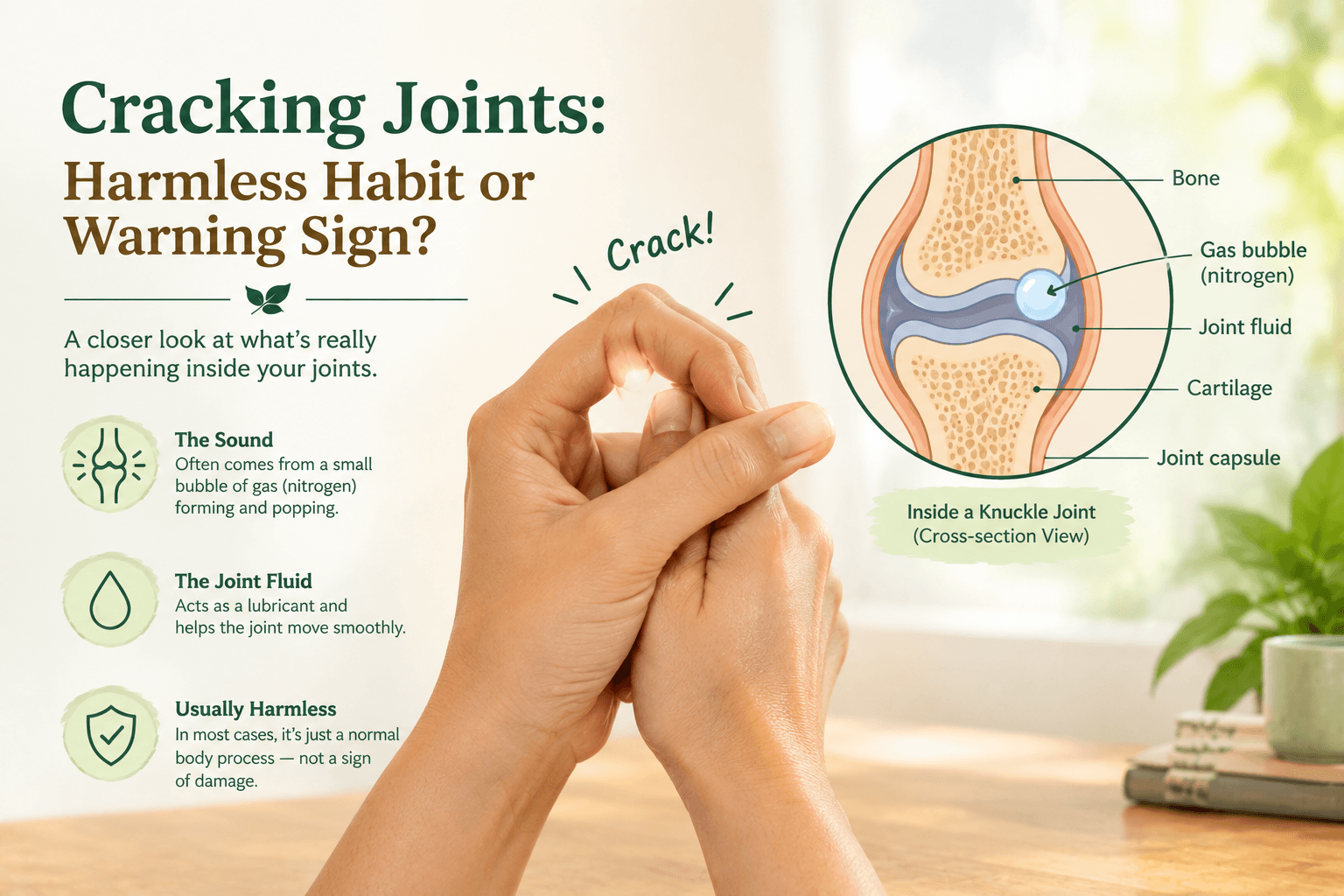
Before we can answer whether joint cracking is harmful, it helps to understand what’s genuinely happening inside your joint when it cracks. Your joints are surrounded by a capsule containing synovial fluid, a lubricating fluid that reduces friction between bones. This fluid contains dissolved gases, primarily nitrogen.
When you crack a knuckle, you’re typically stretching or bending the joint beyond its normal resting position, which rapidly decreases pressure within the joint capsule. This sudden pressure change causes the dissolved gas to be released from the fluid, a process called cavitation. For decades, scientists debated exactly which part of this process actually produces the sound — whether it was the formation of a gas bubble, or its subsequent collapse.
The Scientific Debate Over What Makes the Sound
This is genuinely a more contested question in physics and biomechanics than you might expect, and the research history is worth understanding.
The Early Bubble-Collapse Theory
For much of the 20th century, the dominant theory held that the cracking sound came from the collapse of a cavitation bubble once it had formed in the synovial fluid, similar to how cavitation causes wear on ship propellers in a completely different context. This theory was published and generally accepted starting in 1947 and stood as the standard explanation for roughly 24 years.
Challenges and a New Theory: Tribonucleation
In 1971, researchers challenged this standard view, arguing the exact mechanism remained genuinely unclear. The debate continued for decades until a 2015 study used real-time cine MRI (a type of live video magnetic resonance imaging) to directly visualise what happens inside a joint during cracking. This research found direct evidence that the cracking sound is actually associated with the formation of the cavity itself, rather than its collapse, supporting a mechanism called tribonucleation. Interestingly, the same study found that gas bubbles remained visible in the joint fluid even after the cracking sound occurred, directly contradicting the idea that a collapsing bubble produces the noise, since the bubble was still clearly present afterward.
Why This Debate Matters
Understanding which theory is correct isn’t just academic curiosity — it has genuine implications for understanding whether joint cracking could cause damage. The researchers who conducted the cine MRI study noted that this new framework opens novel avenues for investigating health outcomes associated with joint cracking, since accurately understanding the mechanism is a prerequisite for properly assessing whether the forces involved could plausibly harm joint tissue over time.
The Refractory Period: Why You Can’t Immediately Crack the Same Joint Again
You’ve probably noticed that once you crack a knuckle, you generally can’t crack the exact same joint again right away, no matter how hard you try. This is a genuine, documented physiological phenomenon. After cracking, it typically takes around 15-20 minutes before the joint can be cracked again, reflecting the time needed for the released gas to fully redissolve into the synovial fluid and for the joint space to gradually return to its normal resting distance. This refractory period is actually one of the pieces of evidence researchers have used to help understand and validate the cavitation mechanism itself.
Does Knuckle Cracking Cause Arthritis? What Research Actually Shows
This is genuinely one of the most persistent health myths passed down through generations — “stop cracking your knuckles, you’ll get arthritis” — and it’s worth examining the actual evidence carefully.
The Famous Self-Experiment
One of the most charming pieces of evidence in this area comes from a physician named Donald Unger, who conducted a genuinely dedicated self-experiment: he cracked the knuckles on one hand every day for over 60 years, while deliberately leaving the knuckles on his other hand uncracked, as a personal control. At the end of this decades-long experiment, he found no difference in arthritis between his two hands, a finding that, while just one person’s experience, genuinely earned him an Ig Nobel Prize for his commitment to the question.
Formal Research Studies
Beyond this famous anecdote, more formal research has examined this question properly. A widely cited case-control study examined knuckle cracking and hand osteoarthritis in people aged 50 to 89, representing what researchers described as the most comprehensive evaluation to date of habitual knuckle cracking and its association with hand osteoarthritis. The study’s findings were genuinely clear: the presence of knuckle cracking was not associated with hand osteoarthritis, and notably, the total duration and cumulative lifetime exposure to knuckle cracking also showed no correlation with osteoarthritis development. The researchers concluded that habitual knuckle cracking does not seem to be a risk factor for hand osteoarthritis, even accounting for how long or how often someone had been doing it.
Interestingly, one study noted an inverse correlation between knuckle cracking and osteoarthritis specifically at the metacarpophalangeal joint (the knuckle joint most commonly cracked), meaning crackers in that particular study actually showed somewhat less arthritis at that specific joint, though this single finding shouldn’t be over-interpreted as suggesting cracking is protective — it’s more likely a statistical artefact or reflects other factors researchers haven’t fully isolated.
A Genuinely Important Nuance: Not Risk-Free of All Effects
It’s worth being honest that “doesn’t cause arthritis” isn’t quite the same as “has absolutely no effect whatsoever.” Research has found that habitual knuckle crackers were more likely to show reduced maximal grip strength and more hand swelling compared to non-crackers, even though this didn’t translate into increased arthritis risk specifically. Separately, research has noted that the physical energy produced during knuckle cracking is thought to exceed the theoretical threshold that could cause articular cartilage damage, based on laboratory calculations, which initially seems concerning. However, despite this theoretical possibility, actual observational studies in real people have consistently failed to find that habitual cracking translates into measurable joint degeneration or arthritis in practice, suggesting that whatever happens at a cellular level during cracking, it isn’t translating into the long-term structural damage the theoretical energy calculations alone might predict.
Beyond Knuckles: What About Other Joints That Crack?
Most of the rigorous research specifically on knuckle cracking and arthritis has focused on the hands, since this is the most commonly, deliberately cracked joint. But many people experience cracking or popping in other joints too, including the knees, neck, back, shoulders, hips, and ankles, sometimes during deliberate stretching, and sometimes spontaneously during everyday movement like standing up or climbing stairs.
The same basic cavitation mechanism described above is generally understood to apply across different joints, since they share the same basic synovial joint structure. However, and this is genuinely important, not every joint noise is cavitation-related cracking — some are a different phenomenon entirely, called crepitus, which deserves its own, more careful discussion.
Cracking vs Crepitus: An Important Distinction
This is genuinely one of the most important distinctions to understand when thinking about cracking joints and whether a given noise is something to worry about. While “cracking” and “crepitus” are sometimes used interchangeably in casual conversation, they describe somewhat different phenomena from a clinical perspective.
- Cracking or popping (cavitation-type) — A single, distinct pop or crack, typically associated with the gas-release mechanism described earlier, often occurring with deliberate joint manipulation (like cracking your knuckles) or sometimes spontaneously, such as a knee popping once during a specific movement.
- Crepitus — A broader term describing various joint noises, including grinding, grating, clicking, or crackling sounds, that can occur repeatedly throughout a joint’s range of motion, rather than as a single, isolated event.
Clinically, crepitus is further broken down into different types based on its character and timing: clicking (a single noise at a specific point in movement, sometimes linked to meniscal issues), clunking (often linked to the kneecap repositioning), snapping (often a tendon moving over a bony prominence), and a finer, gritty or grating sound that can occur throughout a joint’s movement and is found in both people with and without symptoms.
Is Crepitus a Warning Sign? What Research Shows
This is where the “harmless habit or warning sign” question genuinely gets more nuanced, and where cracking joints research moves beyond the relatively reassuring knuckle-cracking story.
Crepitus Is Extremely Common, Even in Healthy Joints
Here’s a genuinely important starting point: research has found that an estimated 99% of knees make some sort of physiological noise, and studies examining both symptomatic and pain-free knees have found crepitus present in the vast majority of people regardless of whether they have any knee problems at all. This single fact is genuinely important context — the mere presence of knee noise is not, by itself, something to be alarmed about, given how close to universal it is.
But It Can Still Carry Predictive Value
Despite how common crepitus is, several studies have found it carries genuine statistical significance as a predictor. A notable study using data from the Osteoarthritis Initiative, a major longitudinal research project, found that in people who did not yet have symptomatic knee osteoarthritis, those who reported more frequent crepitus were significantly more likely to develop symptomatic knee osteoarthritis over the following years. The relationship was genuinely dose-dependent: compared to those with no crepitus, the odds of developing symptomatic osteoarthritis were about 1.5 times higher in those with rare crepitus, 1.8 times higher with occasional crepitus, 2.2 times higher with frequent crepitus, and roughly 3 times higher in those who always experienced crepitus. This dose-response pattern, where more frequent symptoms correspond to progressively higher risk, is generally considered a stronger, more convincing type of evidence in research than a simple yes/no association.
An Important Caveat From More Recent Research
More recent research has added genuinely useful nuance to this picture. A 2024 meta-analysis found that similar rates of crepitus were reported across people with various knee conditions and even pain-free individuals, suggesting crepitus isn’t exclusively tied to osteoarthritis or pain disorders specifically. The same research noted that while crepitus appears linked to underlying knee structural changes, this is based on low-to-very-low certainty evidence, and specifically found that while crepitus could predict future symptomatic osteoarthritis, it offered little value in identifying who was at greatest risk of the most severe, end-stage joint disease requiring joint replacement. Researchers in this space have specifically suggested that patients presenting with knee crepitus should be reassured that it’s common across the general population, and while associated with some underlying structural factors, it may not be a direct cause for concern on its own.
Separate, genuinely interesting research specifically examining young adults after ACL reconstruction surgery found that while crepitus was linked to cartilage damage and worse symptoms one year after surgery, it did not predict worse pain or function over the following four years, challenging the assumption that crepitus should be used to diagnose or predict early osteoarthritis in this specific population. This represents a genuinely reassuring finding for younger people who notice noisy knees after an injury or surgery, suggesting the noise alone isn’t necessarily an early warning of inevitable joint deterioration.
Putting This Together Honestly
So where does this leave us? The honest, research-based answer is genuinely nuanced: knee crepitus is extremely common and, especially when it occurs without pain, is often not something to worry about. At the same time, more frequent crepitus, particularly when it begins to occur alongside other symptoms, does carry some genuine statistical association with future symptomatic osteoarthritis in the research literature. This is quite different from the knuckle-cracking story, where decades of research have found essentially no meaningful link to joint disease at all — crepitus in weight-bearing joints like the knee occupies a genuinely more nuanced, “watch and pay attention to accompanying symptoms” category.
How to Tell the Difference: Harmless Noise vs Genuine Warning Sign
Given everything above, here’s a practical way to think about cracking joints you experience:
Signs That Suggest a Harmless Habit
- A single, distinct pop or crack, particularly with deliberate manipulation (like cracking your knuckles)
- No associated pain, swelling, or stiffness
- Full, normal range of motion in the joint
- The joint functions normally during daily activities
- The sound doesn’t change in character or frequency over time
Signs Worth Discussing With a Doctor
- Joint noise accompanied by pain, even mild discomfort
- Swelling around the joint
- Reduced range of motion or stiffness, particularly in the morning
- A sensation of the joint “catching,” locking, or giving way
- Noise that has become noticeably more frequent or changed in character recently
- Joint noise following an injury
- Noise accompanied by visible swelling, warmth, or redness around the joint
This distinction, pain and function versus sound alone, is really the central, practical takeaway from the research: the noise itself is rarely the most important signal. What accompanies it matters considerably more.
Joint Noise During Exercise: What’s Normal?
Many people notice their joints, particularly knees and hips, make noise specifically during exercise, whether squatting, running, or doing yoga. This is genuinely common and, in the absence of pain, is generally not considered a sign to stop exercising or a marker of damage occurring. The repetitive movement, range of motion, and changing loads involved in exercise naturally create more opportunities for the cavitation and crepitus phenomena discussed throughout this article to occur, simply because the joint is moving more and through a fuller range than it typically does during sedentary daily life.
That said, if you notice new joint noise specifically triggered by a particular exercise, especially if it’s accompanied by pain during or after that movement, it’s worth modifying the exercise or having a doctor or physiotherapist assess your form and the specific movement pattern involved, since technique issues can sometimes contribute to joint stress that produces both noise and, potentially, discomfort over time.
A Brief History of the Research Journey
It’s genuinely interesting to step back and appreciate how long scientists have been investigating this seemingly simple question. The first scientific study attempting to describe the origins of joint cracking was published in 1947, proposing the bubble-collapse theory that would stand as the accepted explanation for over two decades. This was challenged in 1971, reopening genuine scientific uncertainty about the precise mechanism. It wasn’t until 2015, using modern real-time MRI technology unavailable to earlier researchers, that scientists could finally directly visualise the process in real time, providing much stronger, more direct evidence for the cavity-formation (tribonucleation) explanation over the older bubble-collapse theory.
This decades-long research journey is a genuinely good reminder that even seemingly simple, everyday phenomena, the kind many of us have experienced since childhood without a second thought, can take remarkably long for science to fully explain. It also reflects well on the broader body of health research into joint cracking: the conclusion that habitual cracking doesn’t cause arthritis isn’t based on a single rushed study, but on a research tradition spanning many decades, multiple independent research groups, and increasingly sophisticated investigative tools.
Common Causes of Joint Noise Beyond Simple Cavitation
Understanding the broader landscape of why joints make noise can help put any specific sound you notice into better context:
- Normal cavitation — The gas-release mechanism discussed throughout this article, generally harmless.
- Tendons moving over bony prominences — Can create a snapping sensation, often around the hip or knee, generally considered a mechanical, benign phenomenon.
- Cartilage changes — In osteoarthritis specifically, roughened cartilage surfaces grinding against each other can produce a grating or grinding sound.
- Kneecap tracking — Normal movement of the kneecap within its groove can sometimes produce clunking or clicking sounds.
- Meniscal changes — Clicking at a specific point during knee movement has sometimes been linked to meniscal tissue changes, though this requires proper clinical evaluation to confirm.
- Age-related joint changes — As joints age, minor structural changes can contribute to more noticeable sounds during movement, often without necessarily indicating a significant problem.
A Special Case: Is Cracking Your Neck Different?
Given how much of the reassuring research discussed above focuses specifically on knuckles and knees, it’s worth addressing neck cracking as a genuinely distinct consideration. The neck houses the vertebral arteries, which supply blood to the brain, running through small bony channels in the cervical vertebrae. While the basic cavitation mechanism in neck joints is understood to be similar to other joints, the neck’s proximity to these important blood vessels and the spinal cord means that forceful or high-velocity manipulation here carries a different risk profile than cracking a knuckle.
This doesn’t mean occasional, gentle neck movement that produces a natural pop is inherently dangerous — many people experience this spontaneously during normal movement without issue. However, it does mean that forceful, deliberate neck cracking, particularly performed with significant force or by someone other than a trained professional, deserves more caution than knuckle cracking. If you regularly feel the need to forcefully crack your neck for relief, this may actually be a sign of underlying muscle tension or joint restriction worth addressing with a doctor or physiotherapist, rather than something to simply keep manually forcing.
Why Do Some People Crack Their Joints Habitually? The Psychological Angle
Beyond the pure biomechanics, it’s worth acknowledging that habitual joint cracking, particularly knuckle cracking, often has a genuinely psychological or behavioural component. Many habitual crackers describe a sensation of tension release or temporary increase in joint range of motion immediately after cracking, which can reinforce the habit over time, similar to other repetitive self-soothing behaviours. Research has specifically noted that knuckle cracking can become habitual partly because of this immediate, tangible sense of tension release and temporarily increased range of motion in the joint, offering a plausible behavioural explanation for why some people develop this as a frequent, almost automatic habit, particularly during times of stress, boredom, or concentration.
Understanding this behavioural dimension is genuinely useful: if you’re trying to reduce a knuckle-cracking habit, for reasons of social preference or a partner’s request for peace and quiet rather than genuine health concern, it may help to address the underlying tension or restlessness driving the habit, rather than simply trying to suppress the urge through willpower alone.
Joint Cracking in Children: Should Parents Be Concerned?
Parents sometimes notice their children’s joints crack or pop, whether during play, stretching, or simply moving around, and wonder whether this is different from the adult experience. Children’s joints are still developing, with growth plates and generally more flexible, elastic connective tissue compared to adults. While there’s less dedicated research specifically focused on joint cracking in children compared to adults, the same basic cavitation mechanism is understood to apply, and there’s no established evidence suggesting occasional, painless joint cracking in children is harmful. As with adults, the same general principle applies: occasional, painless joint sounds are generally not a cause for concern, while any joint noise accompanied by pain, swelling, or a child’s reluctance to use the joint normally warrants a paediatrician’s evaluation.
Lifestyle Habits That Support Healthy, Comfortable Joints
Regardless of whether your joint noise is the harmless kind or something worth monitoring, these habits genuinely support overall joint health:
- Stay consistently active — Regular, appropriate movement supports joint lubrication and the health of surrounding muscles.
- Strengthen muscles around major joints — Particularly the knees and hips, since strong supporting muscles reduce direct stress on joint structures.
- Maintain a healthy body weight — Reduces mechanical load on weight-bearing joints like the knees and hips.
- Warm up before vigorous activity — Supports joint lubrication and reduces strain during exercise.
- Don’t ignore persistent pain — Even if you’ve always assumed your joint noise was harmless, new or worsening pain deserves attention, separate from the noise itself.
- Stay hydrated — Supports overall synovial fluid health and joint lubrication.
The Ayurvedic Perspective on Joint Sounds and Health
In Ayurveda, joint health is closely tied to Vata dosha, which governs movement, dryness, and the nervous system throughout the body. Ayurveda traditionally associates joint sounds, cracking, clicking, or popping, as being linked to the qualities of Vata, particularly its association with air and space, the elements traditionally believed to be involved in the hollow, airy sensations and sounds within joints.
Ayurveda’s traditional perspective offers a genuinely practical lens here too:
- Occasional joint sounds without pain — Traditionally viewed as a normal expression of Vata’s qualities, not inherently a sign of imbalance requiring correction.
- Joint sounds accompanied by pain, stiffness, or dryness — Traditionally associated with aggravated Vata, suggesting the joint may benefit from supportive care like warm oil massage (Abhyanga) and Vata-balancing dietary choices.
- Warm oil massage (Abhyanga) — Traditionally believed to help lubricate joints and support healthy movement, particularly relevant for joints that feel dry or stiff alongside any noise.
- Herbs like Shallaki and Guggul — Traditionally used to help support joint comfort and mobility, particularly when noise is accompanied by discomfort.
- Avoiding excessive dry, cold, or rough qualities — In diet and lifestyle, traditionally believed to support balanced Vata and reduce joint dryness and associated sounds.
This Ayurvedic framework offers a genuinely similar practical distinction to the modern research we’ve covered: sound alone, particularly without discomfort, isn’t necessarily cause for concern, while sound accompanied by pain, stiffness, or dryness is traditionally understood as a signal worth addressing through supportive care.
Common Myths About Cracking Joints
- Myth: Cracking your knuckles causes arthritis. Decades of research, including a dedicated case-control study and a well-known 60-year self-experiment, have found no association between habitual knuckle cracking and hand osteoarthritis.
- Myth: Any joint noise means something is wrong. Research shows knee crepitus specifically occurs in the vast majority of people, with or without any underlying joint condition, making noise alone a poor, unreliable indicator of joint health on its own.
- Myth: You should force a joint to crack if it feels like it “needs to.” There’s no genuine physiological need to crack a joint, and forcing cracking, particularly in the neck or back, should be done cautiously and gently if at all, given these areas’ proximity to more sensitive structures.
- Myth: Joint cracking gets worse or more dangerous as you age. While joint changes do occur with age, research hasn’t established that habitual cracking itself becomes more harmful over time; the relevant factor remains whether pain or dysfunction accompanies the sound, not simply how long someone has been experiencing it.
When to See a Doctor About Joint Noise
Bring your joint noise to a doctor’s attention if you notice:
- Any joint sound accompanied by pain, swelling, or warmth
- A noticeable change in the frequency, character, or intensity of joint noise
- Joint noise that began after an injury
- A sensation of the joint locking, catching, or feeling unstable
- Reduced range of motion alongside the noise
- Joint noise interfering with daily activities or exercise
A doctor can properly assess whether further evaluation, such as imaging, is warranted based on your specific symptoms, rather than relying on the sound alone to determine whether something needs attention.
Frequently Asked Questions
1. Does cracking your knuckles cause arthritis?
No, multiple research studies, including a comprehensive case-control study examining total lifetime knuckle-cracking exposure, have found no association between habitual knuckle cracking and hand osteoarthritis, even in people who had cracked their knuckles for decades.
2. Is it normal for my knees to crack when I climb stairs or squat?
Yes, this is extremely common — research estimates roughly 99% of knees make some physiological noise during movement. As long as this isn’t accompanied by pain, swelling, or reduced function, it’s generally not a cause for concern on its own.
3. When should I worry about a joint that makes noise?
The key signal isn’t the noise itself, but whether it’s accompanied by pain, swelling, stiffness, reduced range of motion, or a sensation of the joint catching or giving way. If any of these accompany the sound, or if the noise began after an injury, it’s worth having a doctor evaluate it.
A Gentle Note Before You Go
Understanding the real science behind cracking joints can genuinely put your mind at ease about most everyday joint sounds, while helping you recognise the specific signs that do warrant a doctor’s attention. If you’re looking for gentle, everyday support for your joints, Healthywe’s range of joint support herbal supplements is made using 100% natural, vegetarian ingredients rooted in traditional Ayurvedic wisdom.
As always, lifestyle habits and herbal supplements are meant to support your overall wellness, not replace medical care. Please consult your doctor or an Ayurvedic practitioner for proper diagnosis, and before making any changes to a prescribed treatment.
Explore our natural wellness range at www.healthywewellness.com/shop.